Google’s AI Mode continues to reshape how local results are presented—and a new visual test is adding another layer to how users evaluate businesses at a glance.
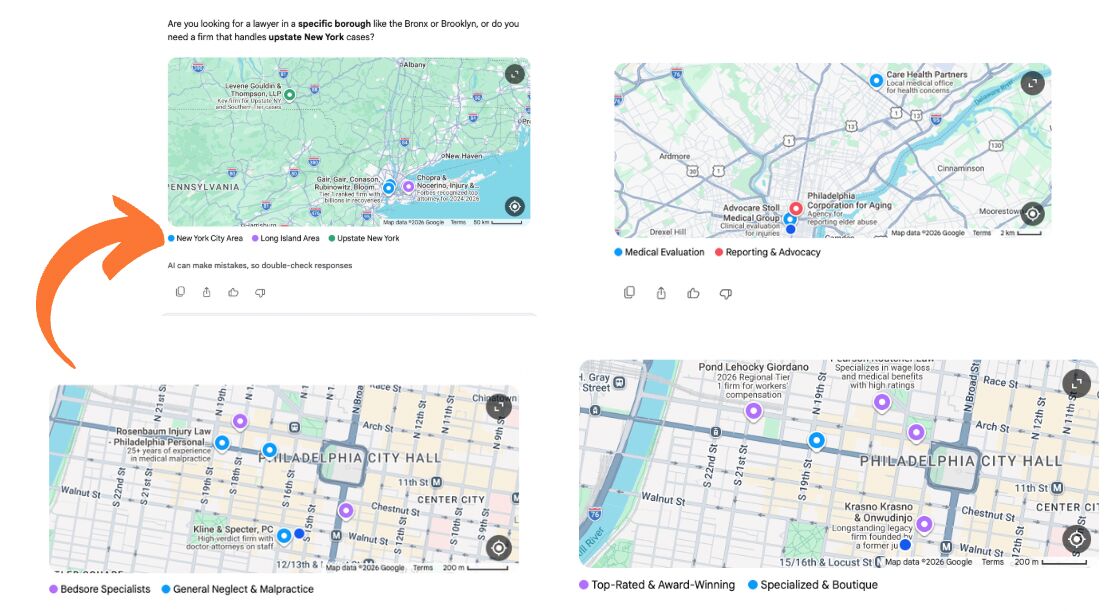
We’re now seeing color-coded map results that categorize businesses based on specific attributes like:
- Geographic relevance
- Business type
- Generalist vs. specialist positioning
- “Top rated” or “award-winning” vs. boutique firms
Instead of a uniform map experience, listings are being visually grouped into distinct segments.
What’s Changing
In this AI-driven layout, Google is:
- Applying different colors to map pins or listings
- Grouping businesses by inferred category or positioning
- Highlighting distinctions like:
- Broad service providers vs. niche specialists
- High-volume firms vs. boutique practices
- Reputation-driven vs. service-specific positioning
The result is a map that doesn’t just show where businesses are—but what type they are.
Why This Matters for Law Firms
Historically, local search has been driven by:
- Proximity
- Reviews
- Relevance
Now, Google appears to be layering in interpretation and classification.
That means your firm may not just be ranked…
It may be categorized.
For example:
- A personal injury firm could be grouped as “generalist” vs. “specialist”
- A smaller firm might appear as “boutique” instead of “top-rated”
- A firm with strong reviews could be visually separated into a premium tier
These visual cues can shape perception before a user ever clicks.
Our Take
This is a meaningful shift toward AI-driven positioning inside the SERP.
Google isn’t just organizing results anymore—it’s framing them.
And that framing may influence:
- Which firms get attention
- How users compare options
- What “type” of firm a user chooses
It also introduces a new challenge:
You may not fully control how Google categorizes your firm.
Which makes your underlying signals—content, reviews, services, branding—even more important.
What ADSQUIRE Is Doing
We’re closely tracking how these classifications appear and what drives them.
SERP Monitoring
- Documenting color-coded variations across markets
- Identifying patterns in how firms are grouped
Positioning Alignment
- Ensuring website and GBP messaging clearly reflect specialization
- Reinforcing key service areas and differentiators
Reputation Signals
- Strengthening review strategy and consistency
- Highlighting credentials, awards, and trust indicators
Local Strategy Adjustments
- Aligning content and structure to influence how Google interprets the firm
- Preparing for more AI-driven categorization across local results
Bottom Line
Google Maps is evolving from a simple location tool into a categorized discovery experience.
And in that experience, how your firm is positioned may matter just as much as where it ranks.
As AI Mode expands, firms that clearly define—and reinforce—their identity will be better positioned to stand out.