Google is adding new AI disclosure settings to its advertising products, giving advertisers more control over how AI-generated and AI-edited assets are labeled in their ads.
This is one we’re happy to see.
As AI becomes increasingly embedded in the ad creation process, advertisers need a clearer way to distinguish between assets created by humans, assets modified with AI, and assets generated entirely by AI.
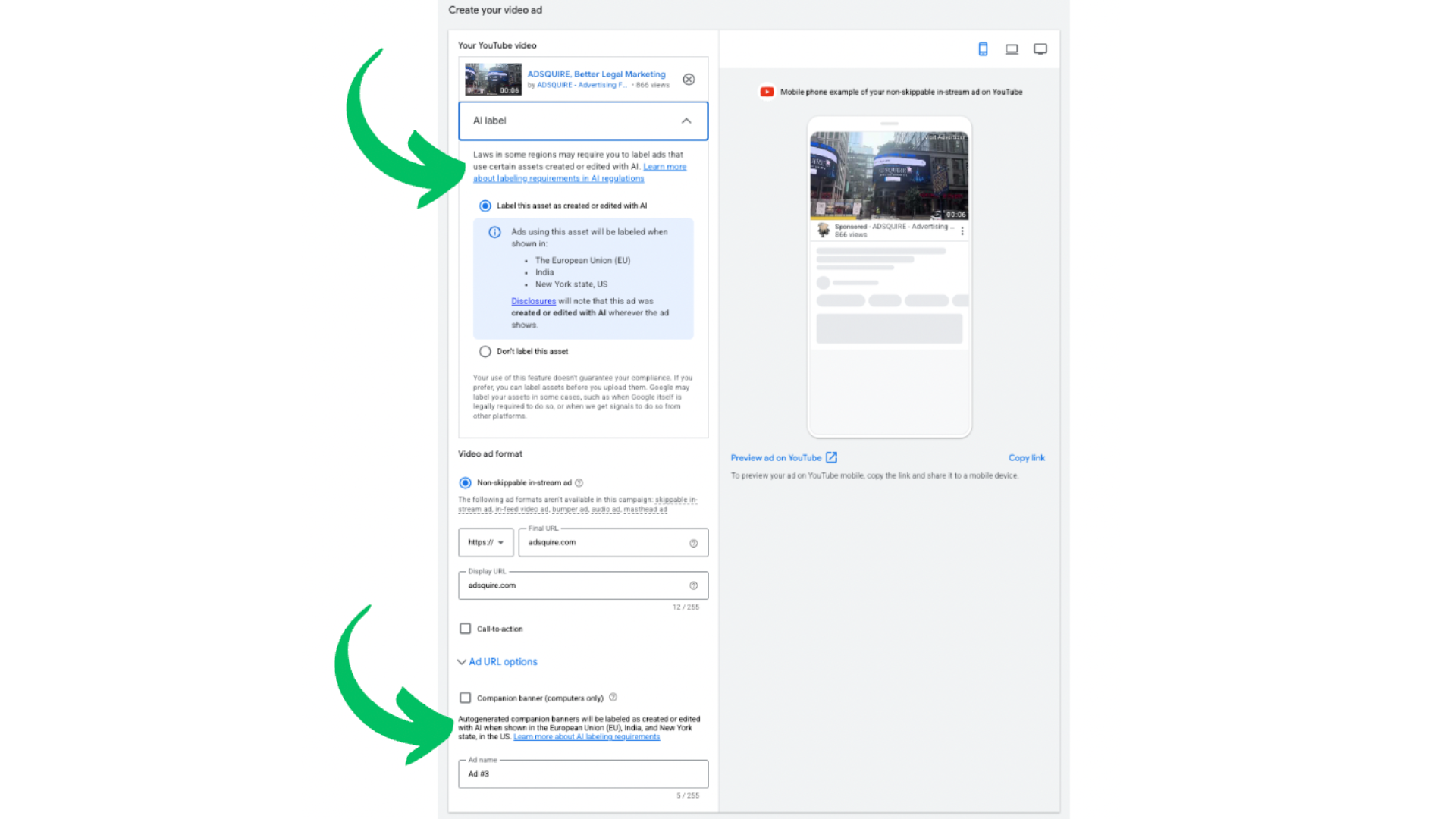
Google’s new AI label settings allow advertisers to designate assets as “created or edited with AI.” Those disclosures can then appear in Google’s ad transparency experiences, and in certain jurisdictions they can also appear directly on the ad itself.
The feature is particularly relevant to YouTube and other visual advertising formats, where AI-generated creative is becoming increasingly common.
What This Means for Advertisers
The new settings give advertisers another layer of control over AI transparency.
Google says advertisers can label assets themselves before uploading them, while Google may also apply labels in certain situations. Those situations can include cases where Google is legally required to label an asset or when Google receives signals indicating that an asset should be labeled from other platforms.
That last part is probably the most interesting piece of the announcement.
Google doesn’t provide much detail about what those “signals” from other platforms actually look like. It raises some obvious questions about how information about an asset’s AI origins may travel between platforms and how those systems determine when an asset should be disclosed.
For advertisers, however, the bigger takeaway is straightforward: AI disclosure is becoming a normal part of digital advertising infrastructure.
And that’s probably a good thing.
Google says the AI label setting doesn’t guarantee compliance with specific regulations, so advertisers are still responsible for understanding the rules that apply to their campaigns.
AI Disclosures Are Also Coming to Autogenerated Companion Banners
Google is also adding AI disclosures to autogenerated YouTube companion banners.
Companion banners appear alongside certain YouTube video ads on desktop, and Google can automatically generate them from a YouTube channel banner.
The new disclosure specifically states that autogenerated companion banners will be labeled as created or edited with AI when shown in the European Union, India, and New York State in the U.S.
That geographic distinction is important because Google says AI labeling requirements are being driven in part by regulations in those jurisdictions.
So even when Google is generating an additional advertising asset automatically, there is now a mechanism for making that AI involvement visible to users.
Our Take
YES. MORE OF THIS.
As much as we’ve criticized Google for continuing to push advertisers toward more automation, this is a part of the AI transition we actually want to see more of.
AI is rapidly becoming embedded into advertising—from generating images and videos to modifying creative and automatically producing additional assets. If platforms are going to automate more of the creative process, advertisers and consumers should have more transparency into what’s actually being generated.
We also like that Google is giving advertisers the ability to label their own assets rather than relying entirely on Google’s systems to figure it out.
The weirdest part is still the language about Google potentially receiving “signals” from other platforms and using those signals to apply labels itself.
We’re curious to see how that works in practice.
But broadly, more disclosure is better than less disclosure.
The advertising industry is entering a world where it may become increasingly difficult to tell what was created by a person, what was modified by AI, and what was generated entirely by a machine.
Knowing the difference shouldn’t be something users have to reverse-engineer.
What ADSQUIRE Is Doing
We’re keeping an eye on how these AI disclosure settings roll out across Google Ads, particularly as more AI-generated and AI-enhanced creative becomes part of standard campaign management.
For advertisers, we’ll be watching:
- Which assets receive AI labels automatically
- How advertiser-applied labels appear across placements
- How disclosures affect YouTube creative
- How autogenerated companion banners are labeled
- How Google’s “signals from other platforms” work in practice
- Which markets receive visible on-ad disclosures
- How these requirements evolve as AI advertising regulations develop
We’re also continuing to distinguish between using AI as a creative tool and outsourcing the creative process entirely to AI.
There’s nothing inherently wrong with using AI to improve or scale an asset. But advertisers should still know what is being created, where it is being used, and how the platform is representing that content to the person seeing the ad.
Conclusion
Google’s new AI disclosure settings are a step in the right direction.
As AI becomes more deeply integrated into advertising, transparency needs to become just as sophisticated as the technology generating the ads.
We’d still like more clarity around exactly what Google means by getting labeling “signals” from other platforms. But giving advertisers more control over AI disclosures—and making AI-generated creative more transparent to consumers—is something we’re happy to see.
If Google is going to give advertisers more AI, we want more transparency right alongside it.