The digital advertising landscape for law firms continues to shift rapidly. From AI-driven ad formats to local search innovations and privacy-first tracking, Google is testing, tweaking, and slowly reshaping how potential clients discover and engage with legal services online. Many changes are subtle tests rather than official rollouts, but together they point to a bigger trend: automation, personalization, and asset-first ad experiences.
Below is what’s moving the needle now, why it matters for your firm, and how we’re responding.
Google Prepping For A Move Away From Responsive Search Ads?
A quiet Google policy update removed longstanding requirements for text ads, responsive ads, image quality, and forms. While it may seem like housekeeping, it hints at a potential complete shift toward dynamic, AI and asset-driven ads in place of Responsive Search Ads—though nothing has been officially confirmed.
Why this matters for law firms
- Traditional ad copywriting as we know it may matter less if Google moves toward more asset-based, AI-assembled ads
- Strong Google Ads assets and Websites/Landing Pages could have newfound importance for messaging control and effective ad copy
Our take
While unconfirmed, the direction suggests more automation and dynamic ad assembly. Our priority remains using our top-performing Responsive Search Ads (RSAs), which still offer the most control over messaging and convert well for law firms.
What ADSQUIRE is doing
- Continuing RSAs as the core search format to maintain messaging control
- Strengthening Google Ads asset libraries
- Monitoring automation trends and testing dynamic formats cautiously
- Preparing clients for potential shifts without sacrificing current performance
Bottom line: Even as Google experiments with fluid, asset-driven ad experiences, high-performing RSAs remain our best tool for controlling messaging and protecting lead quality.
Google Testing “Visits in the Past Month” Callouts on Ads
Google appears to be testing a new credibility-style signal inside search ads showing “Visits in the past month.”
Examples range from 10K+ to over 1M+ monthly visits, displayed directly within the ad unit.
At first glance, it looks like a simple popularity indicator — but the implications could be much bigger.
We’re also seeing cases where multiple ads display identical website stats.
It’s unclear whether this is a bug or a test—but it does highlight Google’s push to bring credibility signals into paid ads.
Why this matters for law firms
For decades, Google maintained a strict separation between paid advertising signals and organic performance metrics.
Advertisers controlled bids, keywords, and ad copy — while organic rankings were driven by authority, content, and engagement.
Displaying website traffic numbers inside ads introduces something new: a signal historically associated with organic performance appearing inside paid placements.
Google Ads Liaison Ginny Marvin clarified that “this is just one of many experiments to show additional information with ads,…ads and organic results remain separate and distinct.”
But, if expanded, this could:
- Give high-traffic firms additional credibility advantages
- Influence user perception and click behavior
- Potentially blur the traditional wall between paid and organic ecosystems
Our take
Right now this is a limited test, and it’s unclear whether it will roll out widely.
But the concept is notable.
Google has already pushed the boundaries of traditional ad structure in recent years — allowing the same advertiser to appear multiple times on page one, expanding broad match, and dynamically repurposing assets across placements.
Adding traffic signals to ads would be another step toward blending search signals into a single experience rather than keeping them separate.
What ADSQUIRE is doing
We’re closely monitoring how this test evolves.
Our focus includes:
- Tracking where the “visits in past month” signal appears
- Evaluating whether it influences click behavior
- Monitoring whether Google introduces additional organic-style signals into paid placements
- Ensuring our clients’ campaigns remain optimized for intent and conversion quality, regardless of UI experiments
Bottom line: This may be just a UI test — but if traffic signals begin appearing inside ads consistently, it could signal a meaningful shift in how Google blends paid and organic search signals.
Google Business Profiles: Autoplay Video & AI Integration
Google is testing a new AI Mode behavior where scrolling through a listing can expand the business profile panel and trigger autoplay video.
Why this matters for law firms
- GBP is evolving from static directories to interactive media experiences
- Video and visual engagement may become ranking or behavioral signals
- Firms may need to expand their video strategy inside GBP, not just on websites or YouTube
Our take
Visual-first local listings are the future. Law firms with optimized photo and video assets will capture attention faster and more effectively.
What ADSQUIRE is doing
- Auditing client GBP photos and media for impact
- Identifying opportunities for short-form video
- Tracking AI Mode engagement to refine local strategies
Bottom line: GBPs are becoming mini content platforms—firms ignoring visual assets risk falling behind.
AI Map Pack Testing: Embedded Organic Links
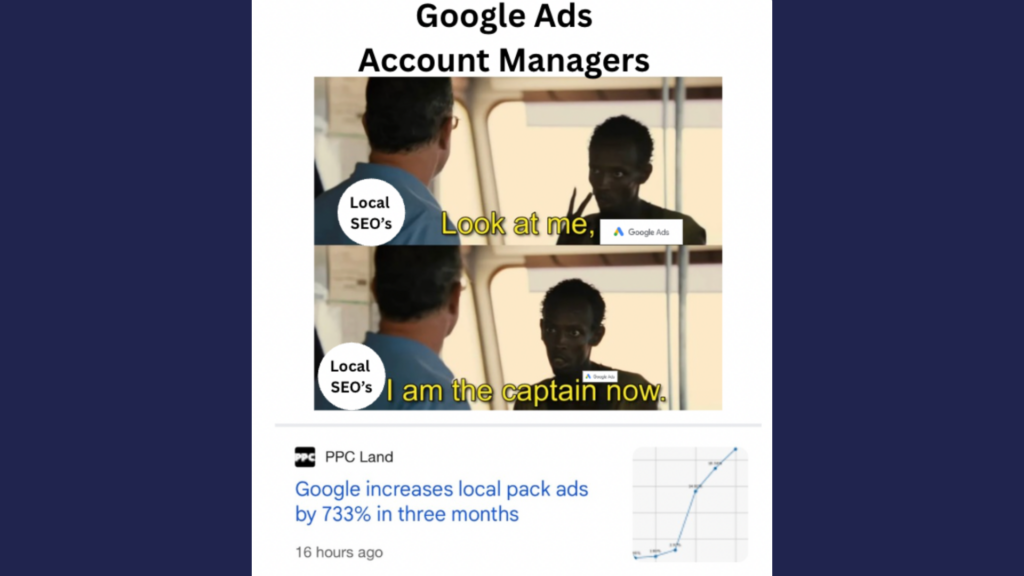
Google is testing map packs with clickable website links, mobile card expansions, and direct integration into LSA funnels.
Why this matters
- The map pack is now a hybrid discovery and lead generation tool
- Organic and paid signals are converging, meaning users may rarely leave Google to contact a firm directly
- Visibility depends on asset structure, not just ranking
Our take
Local search is becoming a unified ecosystem. Firms must align GBP, website, and LSA presence to capture potential clients across all touchpoints.
What ADSQUIRE is doing
- Monitoring map pack layout and link behavior
- Aligning local assets with LSA and website strategy
- Measuring lead flow through interactive map elements
Bottom line: Map packs aren’t just for navigation anymore—they’re evolving into conversion-first interfaces.
AI Maps Are Now Categorizing Law Firms Visually
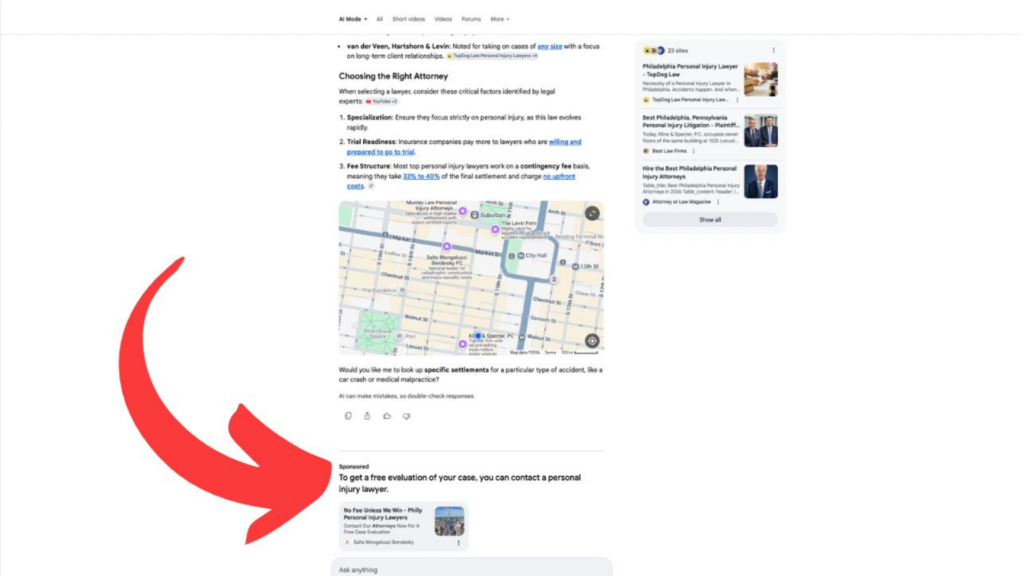
Google is testing color-coded maps in AI Mode, grouping businesses by attributes like specialization, reputation, and positioning (e.g., generalist vs. boutique, top-rated vs. niche).
Why this matters
Users may start evaluating firms based on how Google categorizes them visually, not just rankings or reviews.
Our take
This is a shift toward AI-driven positioning, where your firm’s identity is interpreted—and displayed—by Google.
What ADSQUIRE is doing
- Tracking how firms are categorized
- Aligning messaging with desired positioning
- Strengthening review and credibility signals
Bottom line: In AI-driven local results, how your firm is classified may become just as important as where it appears.
YouTube Sticky Banner Experiment
YouTube is testing a persistent banner that remains after viewers skip ads.
Why this matters
- Provides secondary exposure even after skipping
- Could improve brand recall and engagement
- Changes how performance from skippable ads is measured
Our take
Skipped ads may no longer mean lost impressions. Firms need creative that works for both full-view and partial-view exposure.
What ADSQUIRE is doing
- Designing flexible video assets
- Tracking engagement for sticky banners
- Evaluating brand recall and conversion impact
Bottom line: Skipped ads don’t have to be wasted impressions.
Google Ads Audience-Only Ad Groups
A new recommendation encourages creating ad groups using only audience signals, removing keywords and contextual targeting.
Why this matters
- Expands reach but risks lower-intent traffic
- Legal campaigns rely on high-intent searches
- Audience-only structures can increase impressions but reduce lead quality
Our take
Automation is tempting, but in high-CPC legal verticals, intent protection is critical.
What ADSQUIRE is doing
- Maintaining keyword and contextual targeting where intent matters
- Testing audience-only campaigns in controlled environments
- Prioritizing lead quality over reach
Bottom line: Broader reach isn’t always better. Protecting intent ensures ROI.
Apple Maps Ads Could Open a New Local Channel
Apple is reportedly preparing to launch local ads in Apple Maps, allowing businesses to bid for placement on search queries—similar to Google Maps.
This would mark a major shift, as Apple Maps has historically been ad-free.
Why this matters
For law firms, this introduces a brand-new local advertising channel with potentially lower early competition and high-intent mobile users.
Our take
New platforms create early opportunities. The firms that test first often gain the biggest advantage before the market fills in.
What ADSQUIRE is doing
- Monitoring rollout signals (especially around WWDC)
- Preparing early testing strategies
- Evaluating fit before scaling
Bottom line: If Apple Maps ads launch broadly, this could quickly become a valuable new front for local visibility.
LSA Lead Disputes: Calls from Existing Clients
A recent Local Services Ads (LSA) dispute we dealt with internally resulted in a $400 charge for a call from a current client.
Why this matters
- Historically, Google credited many existing client calls as free, absorbing minor misclassifications
- Recent policy and interface changes have loosened crediting rules and made LSAs appear more “organic,” increasing the risk of accidental charges
- For law firms, even a single misattributed call can significantly impact budgets, given high per-lead costs
Our take
LSAs remain a powerful lead channel, but Google’s shift toward more automated, less clearly differentiated listings raises the risk of paying for non-new leads. Firms must actively verify lead quality and dispute invalid charges rather than assuming historical protections remain.
What ADSQUIRE is doing
- Auditing LSA lead calls for existing clients or misclassified inquiries
- Filing disputes proactively when charges seem inaccurate
- Educating clients to use direct lines for ongoing cases
- Monitoring cost-per-lead trends closely to catch anomalies early
Bottom line: LSAs work—but only if lead classification is verified. Vigilance is now essential as Google experiments with listing presentation and crediting policies.
Google Ads UI Change: Conversion-Only Graph
The default Google Ads view now emphasizes conversions, hiding cost metrics.
Why this matters
- Without cost context, campaign efficiency can be misinterpreted
- In legal verticals, clicks and conversions are expensive—profitability matters
Our take
Conversions are important, but cost-per-lead and spend must be visible. Blindly celebrating results can mislead advertisers.
What ADSQUIRE is doing
- Restoring full metric dashboards
- Monitoring CPA and spend trends
- Evaluating campaigns by true business outcomes
Bottom line: Law firms need visibility into both results and efficiency.
Final Takeaways
Across search, local, video, and AI-driven placements, one trend is clear: advertising is moving toward dynamic, automated, asset-first ecosystems.
For law firms, success depends on:
- Control — Over messaging, data, and brand
- Adaptability — As platforms test constantly
- Strategic oversight — Not blind adoption of automation
At ADSQUIRE, we monitor these shifts daily. Our clients aren’t reacting after performance changes—they’re prepared before the next evolution hits.
If your firm wants to stay ahead as the digital landscape evolves, ADSQUIRE is here to help navigate it strategically.