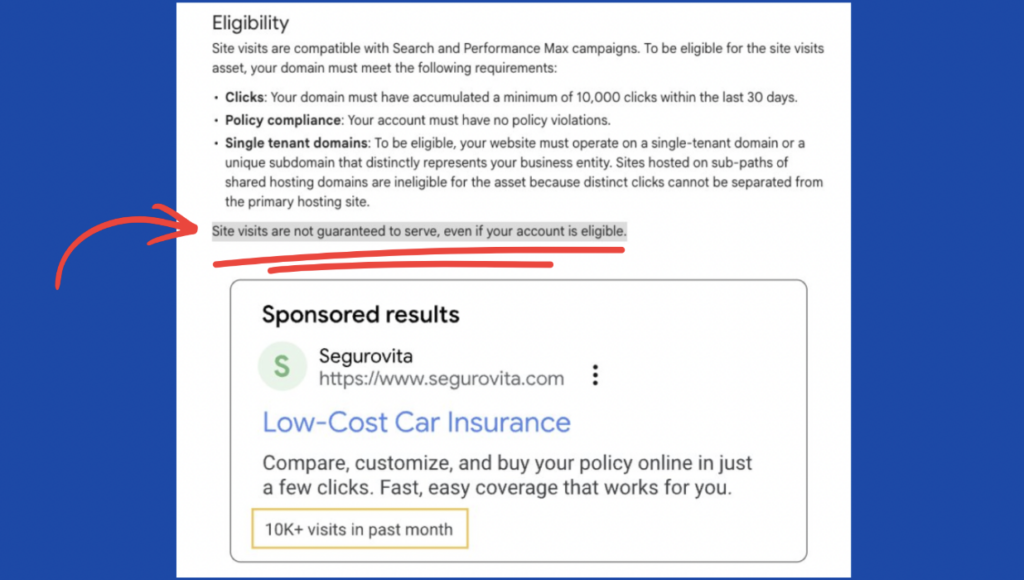
Right after the rollout of “Visits in Past Month” callouts, another interesting behavior has started appearing in Google Ads—one that raises some questions about how these new trust signals are being displayed.
Across certain searches, multiple competing ads are now showing identical website statistics.
What’s Happening
In these cases, advertisers are seeing:
- The same “visit” ranges (10K+, 100K+, etc.) across different firms
- No visible differentiation between competitors
- Stats that appear more standardized than individualized
These signals are intended to function as credibility indicators—giving users a sense of how established or active a business might be.
But when they appear uniformly across multiple ads, it creates a slightly different experience.
Why This Matters
On its own, this could simply be a display issue or a limited test.
But paired with the recent introduction of “Visits in Past Month” callouts, it becomes more notable.
Google is clearly exploring ways to bring additional context and credibility signals into paid ads, likely to help users make quicker decisions.
However, for those signals to be effective, they need to feel:
- Distinct
- Accurate
- Meaningful
When multiple advertisers show the same data, that differentiation naturally becomes less clear.
For law firms—where trust plays a major role in click behavior—that distinction matters.
Our Take
This feels less like a finished feature and more like an early-stage test or inconsistency.
But it does highlight a broader direction:
Google is actively experimenting with how credibility and engagement signals show up inside ads.
We’re seeing:
- Organic-style data points surface in paid placements
- New ways of framing “authority” directly in the SERP
- Continued blending of signals across ad formats
The concept makes sense—help users decide faster.
The execution just isn’t fully refined yet.
What ADSQUIRE Is Doing
We’re keeping a close eye on how these signals evolve and how they impact real performance.
Tracking Where It Appears
- Monitoring queries and markets where duplicate stats show
- Identifying patterns across industries
Evaluating Impact
- Watching CTR and engagement trends
- Comparing performance with and without these callouts
Focusing on Real Differentiation
- Strengthening messaging and positioning within ads
- Prioritizing elements that clearly separate firms
Staying Flexible
- Treating these features as evolving tests
- Adjusting strategy only once behavior becomes consistent
Bottom Line
Google is clearly working to enhance how ads communicate credibility and activity.
Features like “Visits in Past Month”—and the behaviors we’re seeing here—are part of that broader effort.
But as with many early tests, consistency and clarity still need to catch up.
For now, the most reliable way to stand out remains the same:
Clear positioning, strong messaging, and aligning with real user intent.