Google is testing Local Services Ads (LSAs) inside AI Mode, another major change to how local businesses including law firms can appear in Google Search.
The move isn’t entirely surprising. Google has been steadily bringing advertising into its AI-powered search experiences, and LSAs are an obvious candidate given how heavily local and service-based searches rely on them.
But the current experience is raising some serious questions about how useful and user-friendly this new placement actually is.
What Is Happening?
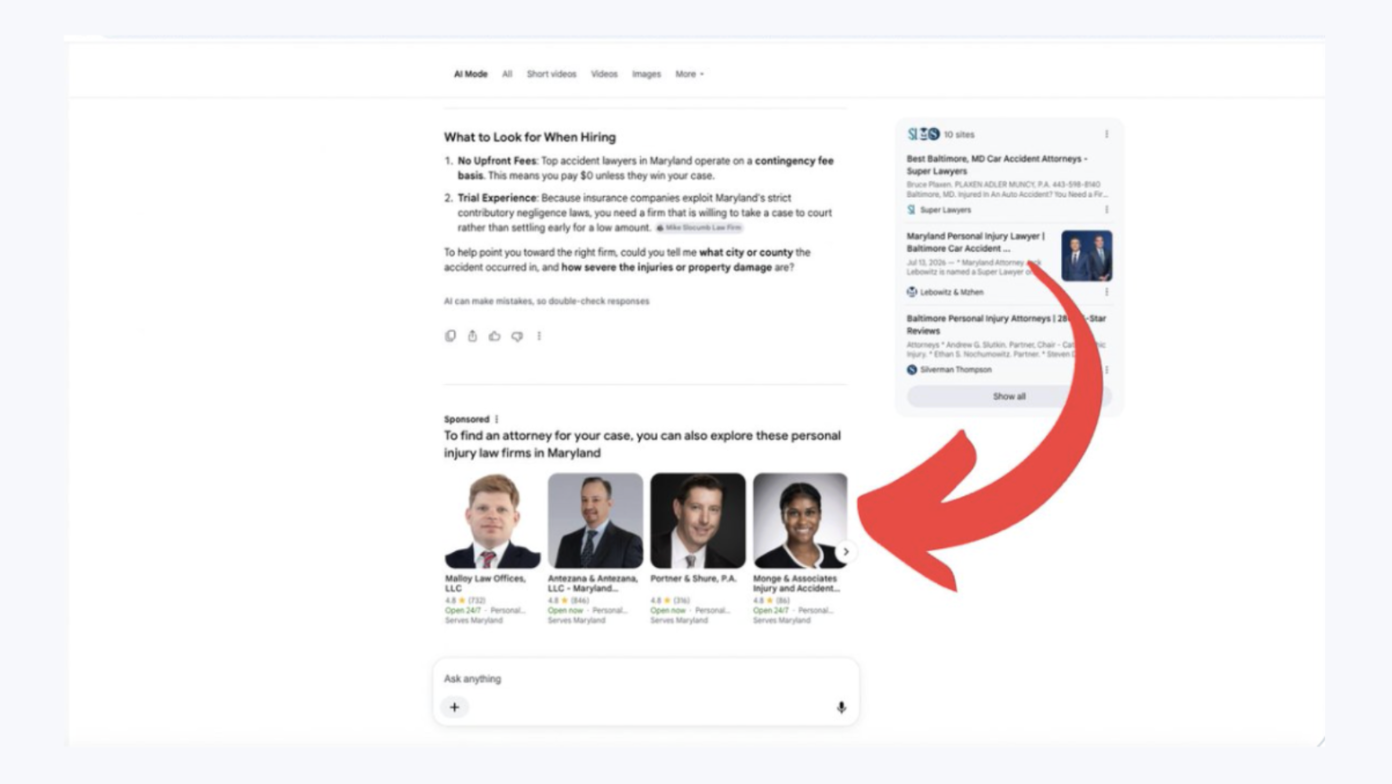
Google is testing LSA placements directly within AI Mode, meaning users can encounter attorney profiles and other local service advertisers while interacting with Google’s AI-generated search experience.
Instead of a traditional search results page with an LSA section at the top, users can potentially see LSA results incorporated into their AI Mode experience.
For law firms, that’s significant because AI Mode is becoming another place where people may research attorneys, legal questions, and potential legal options.
Why This Matters for Law Firms
Consider someone asking Google AI Mode:
“What should I do if I was injured in a car accident in Philadelphia?”
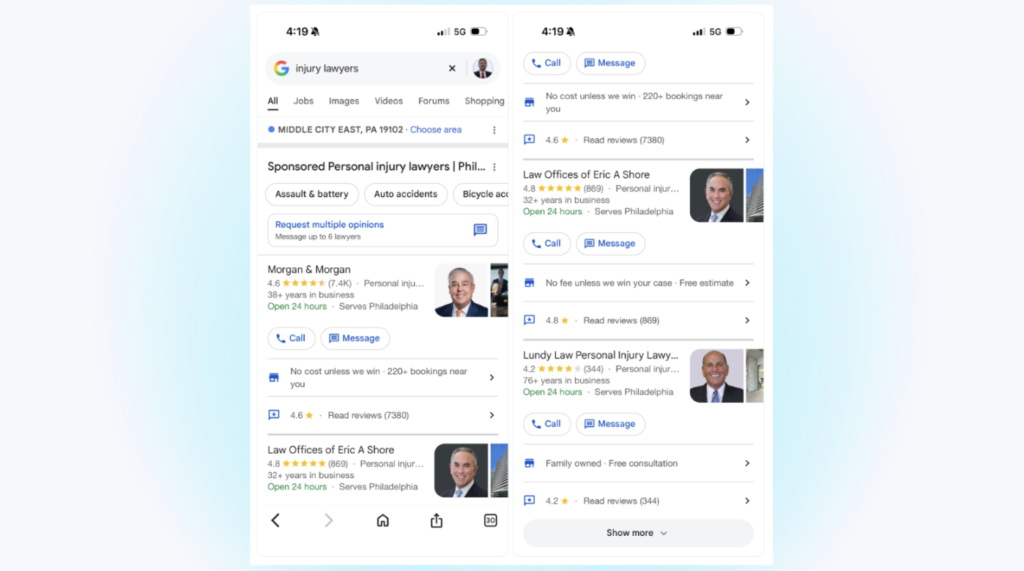
Historically, that type of search might lead to organic results, traditional PPC ads, and potentially LSAs.
Now, Google is experimenting with putting LSAs directly into the AI experience. That could create a new source of highly relevant exposure for law firms.
Legal is particularly interesting here because many legal searches are both local and high-intent. Someone asking AI about a divorce, criminal charge, car accident, or tax problem may eventually want to speak with an attorney. If LSAs are surfaced during that conversation, firms could potentially get in front of prospective clients much earlier in their decision-making process.
But the Current Experience Has Issues
The fact that Google is testing LSAs in AI Mode doesn’t necessarily mean the current implementation is good.
The early experience can feel somewhat forced, particularly when multiple LSA profiles are inserted into an AI-driven conversation.
There’s a legitimate question about whether these placements actually improve the user experience or simply add another layer of advertising to an already changing SERP.
And that’s important because AI Mode isn’t traditional search.
Users are coming to it specifically for a conversational experience. If advertising starts interrupting that experience too aggressively, Google will have to balance monetization with usability.
What Does This Mean for LSA Strategy?
For law firms, it reinforces something we’ve been saying for a while:
LSAs aren’t going away. They’re expanding. Google has continued experimenting with LSA formats, mobile layouts, targeting options, and now AI Mode placements.
That means law firms should continue investing in the fundamentals:
- Maintain a strong review profile
- Keep your LSA profile complete and accurate
- Monitor lead quality, not just lead volume
- Track performance across different search experiences
- Pay attention to how competitors appear
- Make sure your Google Business Profile supports your overall strategy
If LSAs become a core component of AI Mode, having a competitive profile could become even more important.
AI Mode Is Becoming Another Battlefield for Legal Marketing
The bigger story isn’t simply that Google put LSAs in AI Mode. It’s that Google is rebuilding the search experience in real time. AI Mode is becoming a major part of that transition, and advertising is inevitably going to follow.
For law firms, this means the traditional strategy of focusing solely on Google Search Ads and organic rankings is becoming less complete.
The firms that understand how LSAs, PPC, SEO, AI Mode, and Google Business Profiles work together will be in a much better position as the search landscape continues to evolve.
Google’s LSA-in-AI-Mode test may not be perfect right now, but the direction is very clear: If people are using AI to find businesses, Google is going to find ways to put advertisers in that experience.