Google is testing a new Local Services Ads (LSA) configuration on mobile, and it could significantly change how law firms compete for attention at the top of search results.
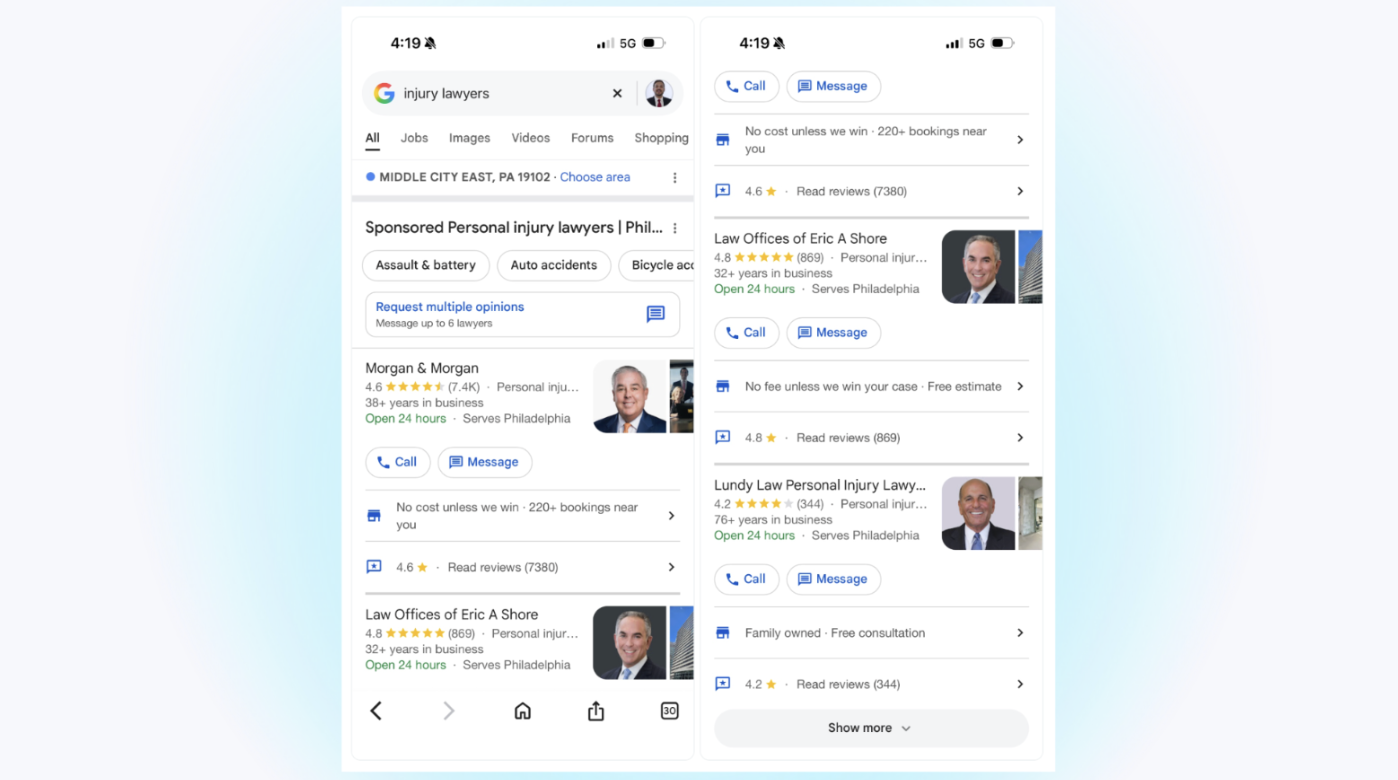
The new format appears to expand LSA profiles substantially, with the LSA section potentially taking up most — or even the entire — above-the-fold experience on a mobile device.
For law firms that rely on LSAs for leads and calls, this is worth watching closely.
What’s Changing?
In the current test, Google is giving individual LSA profiles more space on mobile. Instead of a relatively compact LSA placement, the profiles are expanded and can take up a much larger portion of the screen.
That means someone searching for:
“Philadelphia personal injury lawyer”
could see a much larger LSA experience before reaching traditional PPC ads, organic results, or other listings.
While this gives LSAs more visibility, it also changes how users interact with the search results.
Why This Matters for Law Firms
Legal searches are often high-intent searches.
Someone searching for:
- “car accident lawyer near me”
- “Philadelphia divorce attorney”
- “criminal defense lawyer”
- “workers comp lawyer near me”
may be actively looking for an attorney right now.
If LSAs occupy even more of the screen, the firms appearing in those placements could capture an even larger share of that initial attention.
But there’s a catch: the expanded format could also make the search experience feel more cluttered. Users may have to scroll farther to compare firms or reach organic results and traditional PPC ads.
In other words, Google is making the LSA placement bigger – but bigger doesn’t automatically mean better.
Reviews Could Become Even More Important
When a profile takes up more screen space, the information inside that profile becomes more important.
For law firms, that means your:
- Review rating
- Number of reviews
- Business information
- Photos
- Profile completeness
- Service categories
can make an even bigger first impression.
Consider a firm with a 4.9-star rating and hundreds of reviews competing against a firm with a 4.5-star rating and a few dozen reviews. If both profiles are prominently displayed, that difference is hard to ignore.
LSA optimization and reputation management are becoming increasingly connected.
Don’t Ignore Mobile Performance
If this layout becomes permanent, law firms should be paying particularly close attention to mobile LSA performance.
Look at:
- Mobile vs. desktop leads
- Calls and qualified leads
- Cost per lead
- Which competitors are appearing
- Your review count and rating
- How your profile looks compared with competing firms
And don’t assume the change means you should focus exclusively on LSAs.
Your LSAs, Google Search Ads, organic listings, Google Business Profile, and website all compete for visibility on the same search results page. A strong legal marketing strategy needs to account for all of them.
Is This Going to Become Permanent?
It’s important to remember that this is currently a Google test, so there’s no guarantee this exact configuration becomes the permanent LSA layout. Nonetheless, the direction is worth watching.
Google continues to experiment with how much SERP real estate it gives LSAs, AI features, PPC ads, and other search experiences.
For law firms, the takeaway is simple: Don’t just focus on ranking. Focus on owning the search results.
If Google ultimately gives LSAs even more mobile real estate, having a strong LSA profile could become more valuable than ever – particularly in competitive legal markets.