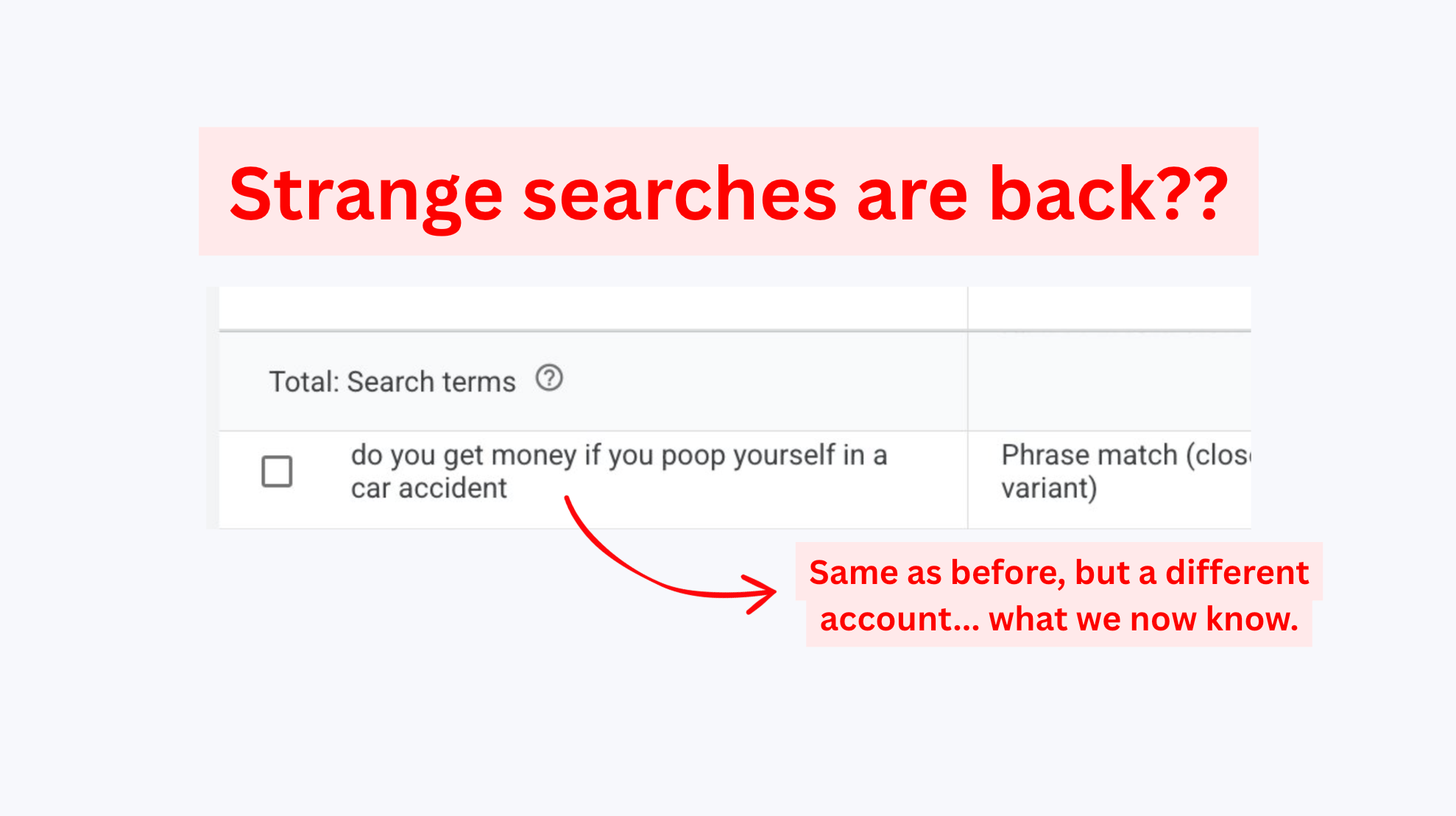
On September 10, a colleague flagged a search term in one of our accounts: a query asking whether you get paid if you soil yourself in a car accident, logged as a close variant in a motor vehicle campaign. Hilarious? Yes, but also concerning. We posted about it that day: see the post
We had seen the pattern before. A strange query shows up once. Then the same phrasing starts climbing, and in the same week, it’s recorded across every account and every geo we manage. How is this possible? Real, in-demand queries do not appear in Philadelphia and Phoenix and Tampa simultaneously with identical wording.
The search terms report is increasingly mapping many typed variations onto a canonical query Google chose, rather than a record of what a person entered.
What This Means for Law Firms
The search terms report is the main tool for finding waste in a legal account. When a click costs $50 – $300 in personal injury, the difference between a real query and a mapped one is the difference between a negative that saves money and a negative that blinds you.
If the reported query is a canonical label, then excluding it does not necessarily exclude the thing that triggered your ad. You may block a phrase, watch it disappear from the report, and keep paying for the same traffic under a different label. Nothing in the interface tells you which happened.
The cross-account pattern matters for budgeting too. When the same odd query trends in every account at once, it reflects the platform, not your market. Reallocating budget or rewriting ad groups because of it is reacting to a reporting artifact.
The deeper shift is where optimization is heading. The more the platform decides what a query “means,” the more it leans on modeled conversions to fill the gap. The counterweight is your own data: call recordings, intake notes, signed cases. That is the one ledger nobody else can rewrite.
Our Take
The pattern is real, and we have watched it for years. The interpretation is ours, and whether Google is doing this deliberately or it is an emergent property of a machine-mediated auction, the practical effect is the same. The report is directional now, not literal.
So we stopped treating it as a ledger. Queries are a signal about intent and theme, not a list of strings to negate. Decisions about where money goes come from the intake desk, not from a query column.
We still watch for anomalies, and we keep a list. A weird query that appears once is noise. The same weird query climbing across accounts and geos is worth documenting, because it tells you when the data layer has shifted under you.
What ADSQUIRE Is Doing
We are rebuilding the feedback loop around data we control. That means:
- Tracking lead quality and signed cases by campaign, not by query string
- Treating search terms as directional themes rather than exact matches
- Logging cross-account query anomalies with dates and screenshots, so a shift is visible when it happens
- Testing negatives in small batches and measuring call volume, not just report changes
- Keeping call tracking and intake source capture independent of platform reporting
- Telling clients when a reporting change is a platform change, not a performance change
For law firms, the goal is not a cleaner search terms report. It is a decision process that does not collapse when the report stops matching reality.
Conclusion
Google’s search terms report is increasingly a mapped label rather than a transcript, and the giveaway is a strange query that spreads across every account and geo at once. For law firms, that undermines the tool most firms use to find wasted spend.
The response is not to stop reading the report. It is to stop making budget decisions from it alone. Platform data tells you where to look. Intake data tells you what happened.
For law firms, the ledger that matters is the one your team writes down when the phone rings. Keep it independent, and the platform’s reporting changes become an annoyance instead of a crisis.