If you feel like every time you blink Google, YouTube, or LSAs have changed… you’re not imagining it. The platforms are evolving faster than most law firms’ marketing teams can refill their coffee. From AI-powered search results taking over SERPs, to YouTube ad pods that make viewers sit through back-to-back commercials, to Local Services Ads masquerading as organic results—it’s a lot to keep track of.
The good news: ADSQUIRE thrives in this chaos. While Google tries to keep users on their platform, we make sure your firm stays front and center with real leads, calls, and form fills. Here’s the latest scoop, why it matters, and what we’re doing to keep our clients’ campaigns performing even as the platforms shift under our feet.
YouTube’s First Position Serving: Because Being Second Is So Last Year
YouTube rolled out First Position Serving, guaranteeing your ad appears first in an ad pod. Why care? Because if you’re second or third, viewers often hit “skip” before your message even starts. Currently, it’s only available through reservation buying, but we expect it to expand soon.
Ad Pods Are Everywhere:
- Pre-roll: Two ads play before your video starts.
- Mid-roll: Two or more ads interrupt longer content.
- End pods: Ads appear after the video finishes.
Why This Matters for Law Firms: Being first means higher engagement, more completed views, and a better chance potential clients actually see your ad. It likely comes at a premium, but the payoff is stronger watch time, visibility and increases in branded searches back to your firm.
Our Take: Sure, it costs more. But First Position is going to be essential if you want viewers to actually watch your message.
What ADSQUIRE Is Doing:
- Testing First Position reservation buys.
- Tracking cost differences and watch-time metrics.
- Ensuring clients get premium visibility where it counts most.
YouTube Network: Breaking Free From SPN
Google is exploring a standalone YouTube Network, separate from the Search Partner Network (SPN). Natasha Kaurra recently shared a survey highlighting this possibility, showing that Google is actively testing ways for advertisers to:
- Target all YouTube inventory directly
- Separate YouTube from the broader, often unpredictable and lower value placements on the SPN
- Apply contextual targeting along watch journeys and in the YouTube discovery feed.
This move actually feels like the culmination of a long-term strategy. Over the past three years, Google has quietly trimmed down SPN, de-prioritizing smaller blogs and pushing traffic toward larger, higher-value publishers. AdSense rule changes further nudged smaller sites out of the monetization pool. Only last month did advertisers finally get full SPN placement visibility, after decades of asking. Now, YouTube seems poised to become its own traffic bucket, consolidating engagement under a Google-owned property.
Why This Matters for Law Firms: A dedicated YouTube Network could be a huge win for legal advertisers. Instead of worrying about your ads showing up on random, low-quality partner sites, you’d get:
- Cleaner control over where your budget goes
- Video-first campaigns without wasted spend
- Greater transparency for compliance-minded firms
- Better placements where actual real users are spending time
Our Take: Finally, a way to potentially just target YouTube. Costs may rise (Google does love taxing clarity), but the tradeoff is worth it for predictable, brand-safe video campaigns. We are praying this one come to fruition, but this is very early and in surveys at present. Stay tuned.
What ADSQUIRE Is Doing:
- Monitoring for a potential rollout depending on survey results
- Working on stronger YouTube creatives
- Internally prepping to dip our toe into the YouTube Network if it happens
- Using creative strategies on current display network
- Staying away from the SPN in most cases
The LSA Badge Saga Continues
Google removed all LSA checkmarks last month and promised a single Google Verified badge in October. Until then, LSAs look just like organic results—and yes, people are already clicking without realizing they’re ads.
What We’re Seeing, Anecdotally:
- Users leaving reviews as message leads instead of leaving reviews on GBP
- Platform drives people to call or message without reading much
- LSAs remain confusing, as badges and other trust signals that help filter out lower-intent users are gone.
Remember: LSAs are pay-per-lead, not pay-per-click, so the focus should be on actual leads, not impressions.
Our Take: Message leads aren’t worth it. Calls are higher intent, easier to track, and more likely to convert.
What ADSQUIRE Is Doing:
- Optimizing campaigns for call leads only
- Monitoring lead quality closely
- Using the feedback form to dispute low-value interactions & ACTUALLY still getting leads credited this way!
First Legal AI Overview Ad Spotted
Our very own Elie Kalim spotted Google testing AI Overview (AIO) ads for the legal vertical:
- Search: “estate and trust litigation faq”
- Google displayed: “Some services that can help you create an estate plan are:”
- Standalone ad for LegalZoom (not technically a law firm yet, but still a legal player)
Why It Matters: AI Overview ads are quickly becoming a monetized space. As AI-generated answers appear at the top of search results, organic clicks may decline because users get their questions answered without ever scrolling to traditional listings. This shift means that law firms can no longer rely solely on standard SEO: they need to understand how their practice areas may show up in AI Overviews and start testing placements early.
Early testing isn’t just about visibility; it’s about establishing a presence in a space that Google is actively shaping and monetizing. Firms that wait risk playing catch-up, while those who prepare now can position themselves as the authoritative, visible option in AI-driven search results.
Our Take: Google is one step closer into the legal vertical. Law firms who wait will have to play catch up, while those who prep for this change will dominate the SERPs.
What ADSQUIRE Is Doing:
- P-Max campaigns ready for current clients
- Monitoring rollout to explore more controlled options beyond P-Max
- Balancing early adoption with performance oversight
- Experimenting with a new AI LLM strategy that is starting to bear fruit! Want in? Set up a quick call so we can show what we are doing here. Keeping this one confidential and for client ONLY!
YouTube AI & Affiliate Ads
What’s Changing:
- AI-Enhanced Creator Videos: Automatic edits, background generation, and voice adjustments are making content look more polished with less effort.
- Affiliate Link Stickers: Product-style stickers now appear in ads and Shorts, blurring the line between content and promotion.
Implications for Law Firms: Audiences are growing accustomed to seamless, high-quality content—even in professional spaces. But while polished copy matters, credibility and transparency remain non-negotiable. Just because viewers expect slick videos doesn’t mean lawyers can skip clarity or honesty.
Our Take: Use AI selectively. It’s a great way to improve efficiency and production quality, but authenticity is what builds trust. Affiliate-style ads highlight a larger trend: audiences now expect content to feel natural and integrated, not disruptive. This is more true of the shorts ad format. You need the right creative for the right platform. While high production TV style ads still work like gangbusters on regular YouTube placements, UCG style is what dominates and works on shorts.
What ADSQUIRE Is Doing:
- Prioritizing authentic, human-feeling content for shorts ads and organic placements.
- Ensuring clear disclosures are always included
- Designing smarter storytelling with creatives that fit in with organic content without feeling overly “ad-y”
- Testing sticker add ons in content to mimic what YouTube is doing behind the scenes.
Pre-Populated AI Follow-Up Questions
What’s Changing: Google now suggests follow-up questions during searches, guiding users to the next logical query. These suggestions keep users engaged longer—and our prediction: ads will eventually occupy these high-intent spots.
Our Take: Search is becoming less about user-generated queries and more about platform-guided discovery. This is both a challenge and an opportunity: the places Google chooses to surface follow-ups are also prime points for advertising.
What ADSQUIRE Is Doing:
- Monitoring emerging follow-up questions to see where intent is highest
- Aligning content and campaigns with these new AI-driven queries
- Preparing ad strategies to plug into these spots as soon as they become available
- Using these suggestions on “query fan out” with our new strategy! Clients who are already using are loving the concept! Inquire or set up a call. There are never any extra charges for these hot discoveries for our clients!
Tools We’re Loving
Even in the midst of Google’s chaos, there are some bright spots in the toolbox. Here’s what’s caught our eye recently:
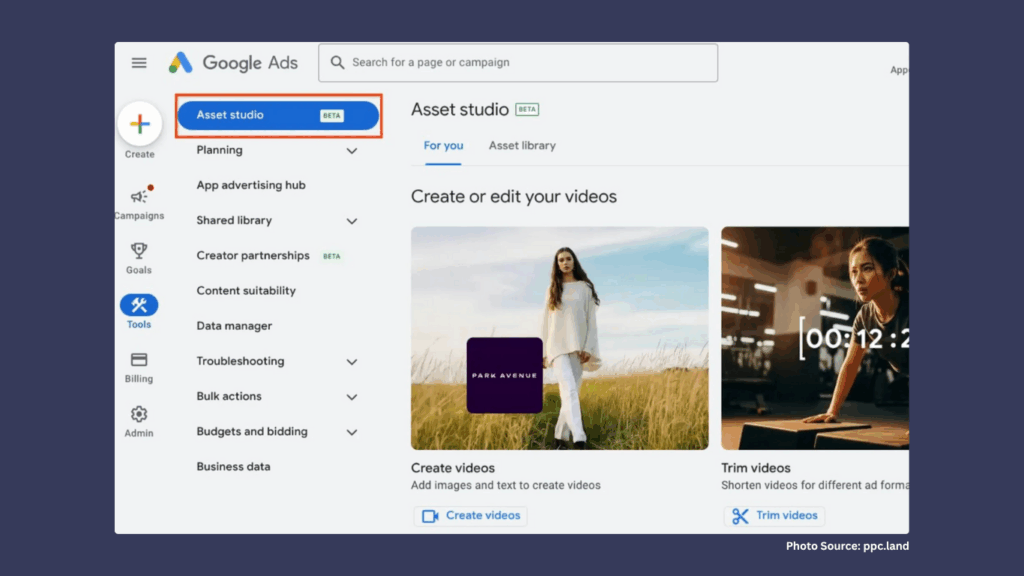
- Asset Studio (Beta) – Advanced in-platform editing for ads, images, and videos. Not in all accounts yet, but it helps scale and polish assets quickly. Great for efficiency… just don’t let AI write your disclaimers.
- Google Ads Main Graph Dashboard (Beta) – New charts showing metrics like Conversion Delay right at a glance. Cleaner design, bigger metric boxes, and adjustable charts make spotting trends faster. Google’s trying to make performance review “easy,” but you still need someone who actually understands what’s happening behind the scenes. IMPORTANT note on this new beta: Google is trying to slowly add in “forecasting models” into this main graph to force more budget increase suggestions. Currently they are including “estimated conversion data” into the graph. These are NOT real conversions and are mostly at this point made up to guide budget increases. We are hoping that some day in the future forecasting may be better, but at this point its not that great so use with caution and make sure you understand that the conversions displayed are “estimated forecasts” and not 100% valid.
- LSA Feedback Form – Did you get charged for a nonsense lead? Mark it “Very Dissatisfied” and tell Google why. It won’t work every single time, but if you are lucky, you can get your low-quality lead refunded by Google. This STILL works for us about 30-40% on leads that are clearly not good and or spam. We ALWAYS do this for our current clients so not to worry, if its spam we got you and are all over it!
Our Take: These tools are helpful, but the key is knowing which suggestions to trust and which to question. That’s where an experienced agency comes in—someone who can see through the shiny charts and beta bells-and-whistles to get real results.
What’s Changing:
- Up to 25 exact or phrase-match exclusions for ad copy
- Message restrictions to control what Google can say in your ads
- Up to 40 combined restrictions and exclusions per campaign
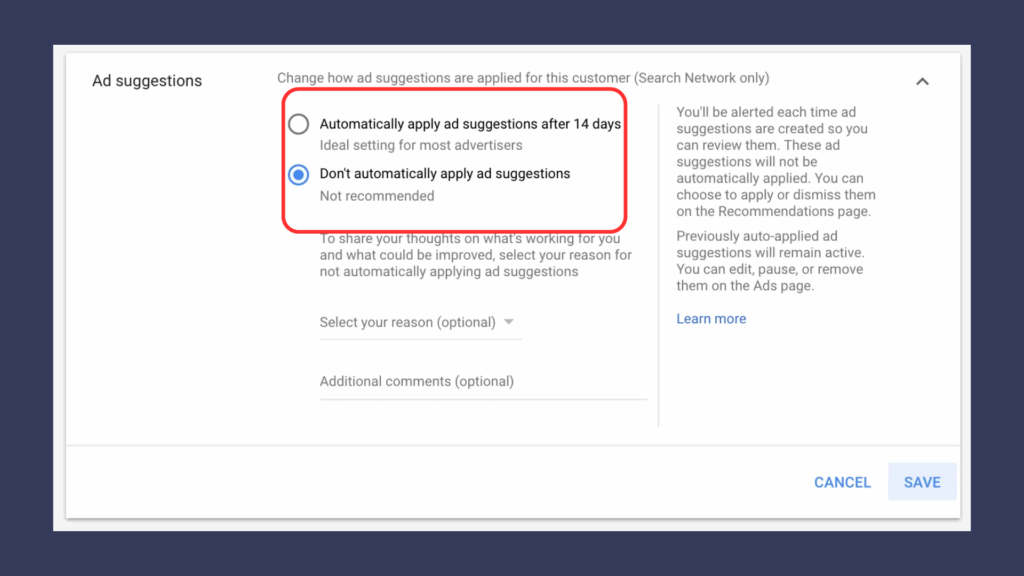
Why It Matters: On paper, this looks like more control—but in reality, it’s mostly limiting what we can filter, not giving full oversight. Classic PMax: it promises flexibility but still funnels campaigns through Google’s optimization engine. For legal advertising, tone, compliance, and clarity are critical, so we can’t just let the algorithm do its thing.
Our Take: This is basically the same balancing act we’ve accepted with PMax: more “controls” that are actually restrictions. You need strategy to make them work without throttling performance.
What ADSQUIRE Is Doing:
- Developing strategies to best control ad copy messaging within these limits
- Building brand-safe exclusion lists tailored to legal campaigns
- Applying guided messaging restrictions thoughtfully, so campaigns stay compliant but still effective
- Maintaining flexibility so the algorithm can optimize while keeping messaging on-brand
- But for now until AI overview and or AI mode ads actually roll out more broadly we have scaled back significantly on any client P-max campaigns. We are keeping these humming on less than 1 dollar a day and working them to be ready if AI ads ever do actually get a broader roll out. Only time will tell but we are always searching!
The Big Picture
Google, YouTube, LSAs — they’re all rewriting the rules faster than most of us can sip a coffee. Ads are blending into content, AI is taking over SERPs, and viewers are being conditioned for back-to-back ad marathons.
At ADSQUIRE, we cut through the noise. We focus on calls, form fills, and real leads, leveraging multi-channel strategies, selective AI adoption, and early testing of new placements to make sure law firms don’t just survive the chaos — they thrive in it.
Platforms may change, rules may shift, and badges may disappear, but potential clients calling your office isn’t optional — it’s mandatory. We’re here to make sure you get them.