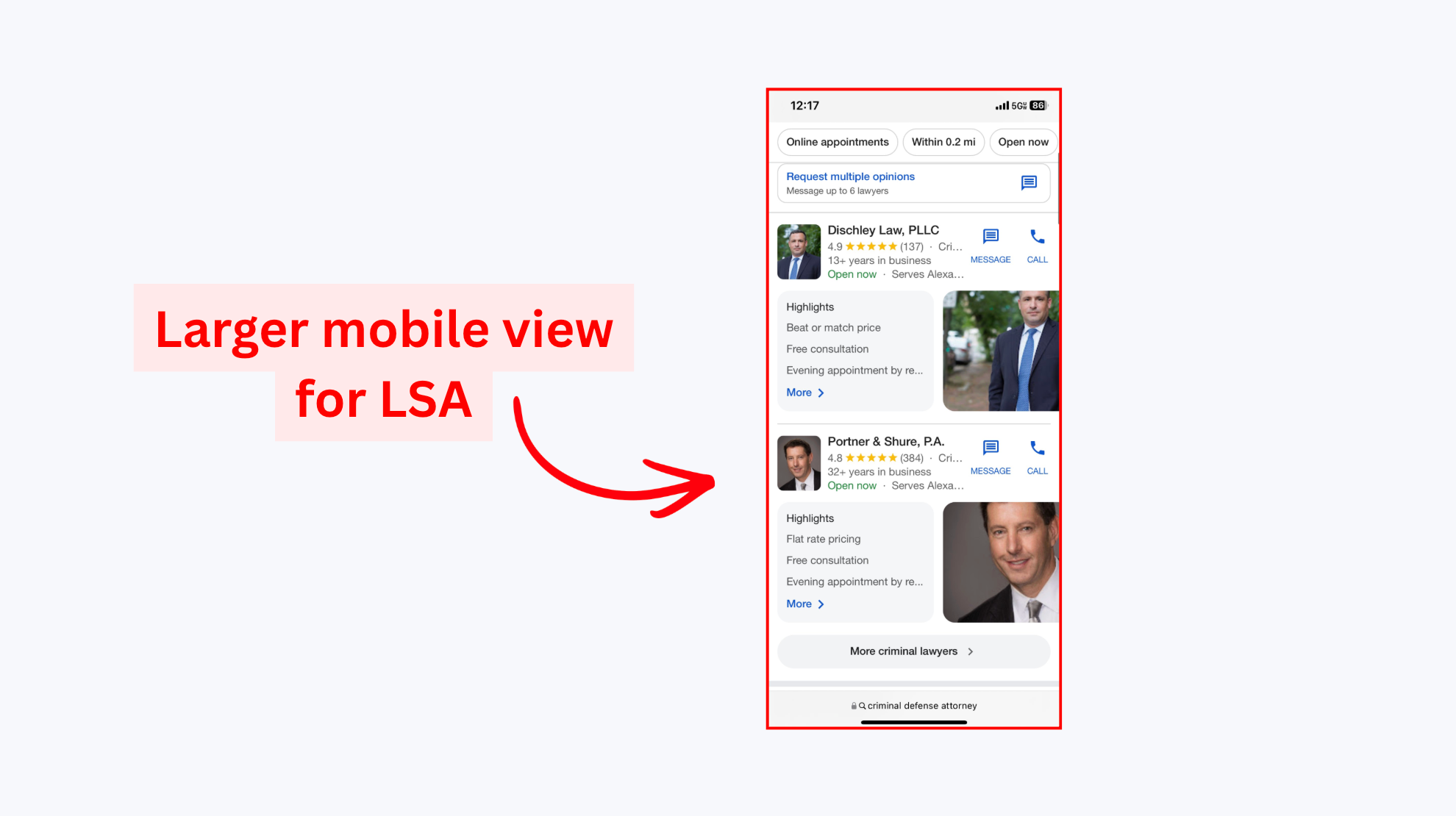
On September 23, Google was spotted testing a larger Local Services Ads listing on mobile. A criminal defense search showed two firms filling most of the screen: photo, star rating and review count, years in business, “Open now,” service area, message and call buttons, and a highlights block listing “Beat or match price,” “Free consultation,” and evening appointments. We posted about it that day: see the post
The larger format lands while Google is migrating Local Services Ads into Google Ads. Existing LSA campaigns are becoming a pay-per-lead Performance Max campaign type, starting with US home and storefront categories in August and expanding through late 2026, with non-US accounts and remaining categories following in 2027.
Read together, the two moves point the same direction. Google is putting more resources behind LSA formatting and giving it more space on the page, while moving its management into the platform where the automation and reporting already live. More surface, fewer manual controls.
What This Means for Law Firms
The bigger listing changes what wins. When a unit is two lines of text, rank and review count do most of the work. When it fills half the screen, the profile itself is the ad: the photo, the rating, the number of reviews, and the highlights. Firms with a stock headshot, eleven reviews, and no filled-out attributes will lose to a competitor who looks established.
The highlights deserve a compliance review of their own. “Beat or match price” and “flat rate pricing” appeared on attorney listings in that test. Those are pricing claims, and a price claim about legal services has to be accurate and, in some states, explained. A firm that never wrote that sentence may still be showing it.
There is a new lead mechanic in the format too. The test included a “Request multiple opinions” box offering to message up to six lawyers at once. More of those leads will be shared with five competitors. A firm that measures lead volume will love it. A firm that measures signed cases may not.
The migration matters for the same reason. Manual cost-per-lead bids and vertical-level target CPA are going away, weekly budgets convert to daily, and historical performance reports do not carry over. Firms that have not exported their LSA data before their migration date will lose the baseline they use to judge every future month.
Our Take
Bigger ads are not automatically better leads. The format rewards the things legal advertisers chronically neglect: real photos, steady review generation, fast response, and complete profiles. Google is not making the channel easier. It is making presentation matter more, which favors firms willing to do the unglamorous work.
The migration is where firms will feel a real loss of control. Manual bids and category-level target CPA were crude, but they let an agency hold a line on cost per lead in a market where one practice area is worth three times another. Replacing that means splitting campaigns by practice area so a single blended target does not quietly subsidize the wrong cases.
We are not treating the bigger format as a reason to raise budgets. We are treating it as a reason to fix the profile first. A firm with 400 reviews and a strong photo can compete in a larger unit at the same spend. A firm with a thin profile cannot, and spending more will not fix it.
What ADSQUIRE Is Doing
We are working on both changes at once. That means:
- Auditing LSA profiles for photos, review counts, hours, and attributes before the larger format reaches a client’s market
- Reviewing highlights and price claims for accuracy and state bar compliance
- Exporting historical LSA performance data now, before each account’s migration date
- Splitting practice areas into separate pay-per-lead campaigns so target CPA stays controllable
- Tracking cost per signed case, not cost per lead, as shared-lead formats expand
- Documenting baselines so the post-migration reporting gap does not become a blind spot
- Watching where the larger units serve before recommending spend changes
For law firms, the format is not the strategy. The profile and the intake behind it are.
Conclusion
Local Services Ads are getting bigger listings and moving into Google Ads, and both changes reach the same place: more visibility, less manual control, and more weight on how the firm presents itself.
The firms that benefit will be the ones with complete profiles, current reviews, and campaigns segmented enough to keep bidding honest. The firms that lose will be the ones that treat a bigger ad as a substitute for a better one.
For law firms, the format will keep changing. What the profile says about the firm will not.