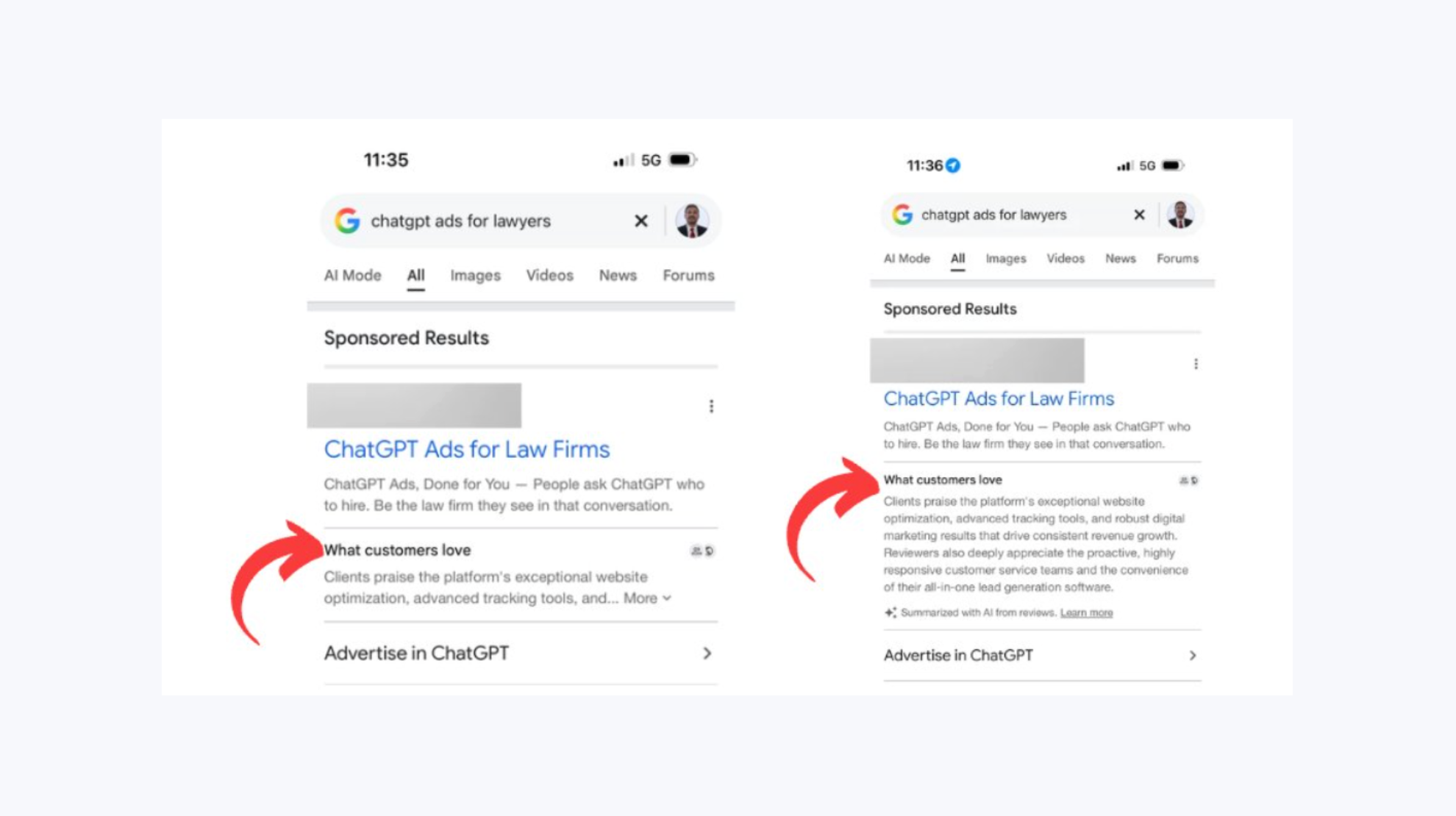
On September 25, a sponsored result for “chatgpt ads for lawyers” carried a section labeled “What customers love,” followed by a paragraph of praise about the platform’s website optimization, tracking tools, and revenue growth, attributed to customer reviews with a “Summarized with AI from reviews” note. We posted it that day: see the post
It was not a feature the advertiser opted into, and it was not a review of the advertiser. The summary described the product category the ad was selling, generated from reviews across the web and placed inside a paid placement.
Google has since documented the format. Its help page describes AI-generated review summaries that “highlight positive insights from across the web,” available on Search campaigns in the US, UK, Australia, and India in English, on all positions on Google.com. Summaries are positive only, appear only when Google predicts they will improve performance, and advertisers cannot edit them.
What This Means for Law Firms
In legal advertising, a testimonial is a regulated communication. Several states require disclaimers when a firm uses client statements, particularly about results. Others restrict testimonials that imply a guarantee or that are not representative. Every one of those rules assumes the firm chose the words.
Here nobody chose the words. Google selected positive material, wrote the summary, and attached it to the firm’s paid ad. The firm cannot edit it, cannot preview every instance, and the help page does not describe an opt-out or a report showing when a summary ran.
That is the exposure. A generated line about winning results, or about how a firm “got me more than expected,” is a claim in the firm’s advertisement. Model Rule 7.1 does not have an exception for text a platform wrote.
The screenshot also shows the accuracy problem. The summary on that ad described ChatGPT Ads, not the agency paying for the placement. Grounding the text in “reviews across the web” means the source could be a review of a different business, a different product, or a category, and the ad carries it anyway.
Our Take
This is the feature we have the most mixed feelings about. Free social proof inside the ad is genuinely useful, and most firms will never generate enough reviews on their own to fill that space. Google is handing out credibility at the moment of decision.
The problem is that it is credibility nobody approved. For an ecommerce brand, a slightly off summary is a conversion problem. For a law firm, it is a bar complaint waiting for the right reader, and the firm cannot correct the sentence because the platform says the text represents user feedback.
We would rather have the control than the free line. If a firm wants testimonials in an ad, we will write them, disclose them as the state requires, and keep the proof on file. A summary we cannot edit and cannot audit is not a testimonial strategy. It is a liability with good typography.
What ADSQUIRE Is Doing
We are treating the summaries as ad copy we are responsible for. That means:
- Checking live ads in each market for review summaries and capturing what they say
- Auditing the review corpus behind them, so the material Google reads is accurate and about the right business
- Reviewing any summary that appears against the firm’s state testimonial and disclaimer rules
- Documenting what ran, when, and where, because there is no reporting column for it
- Asking Google for a control, and checking whether account-level automated asset settings apply
- Escalating summaries that misstate results or describe the wrong business
- Telling clients plainly that this text exists even when they did not write it
For law firms, the goal is not to remove every positive mention. It is to make sure no claim about the firm runs without someone accountable for it.
Conclusion
Google is writing positive-only review summaries into Search ads, and advertisers cannot edit them. For most categories that is a small trade of control for credibility. For law firms, it is an unapproved testimonial in a category where testimonials are rules, not decoration.
The feature will keep spreading. The help page already covers four markets, and the tests date back almost a year.
For law firms, the standard does not move. If it appears in your ad, it is your advertisement, whoever typed it.