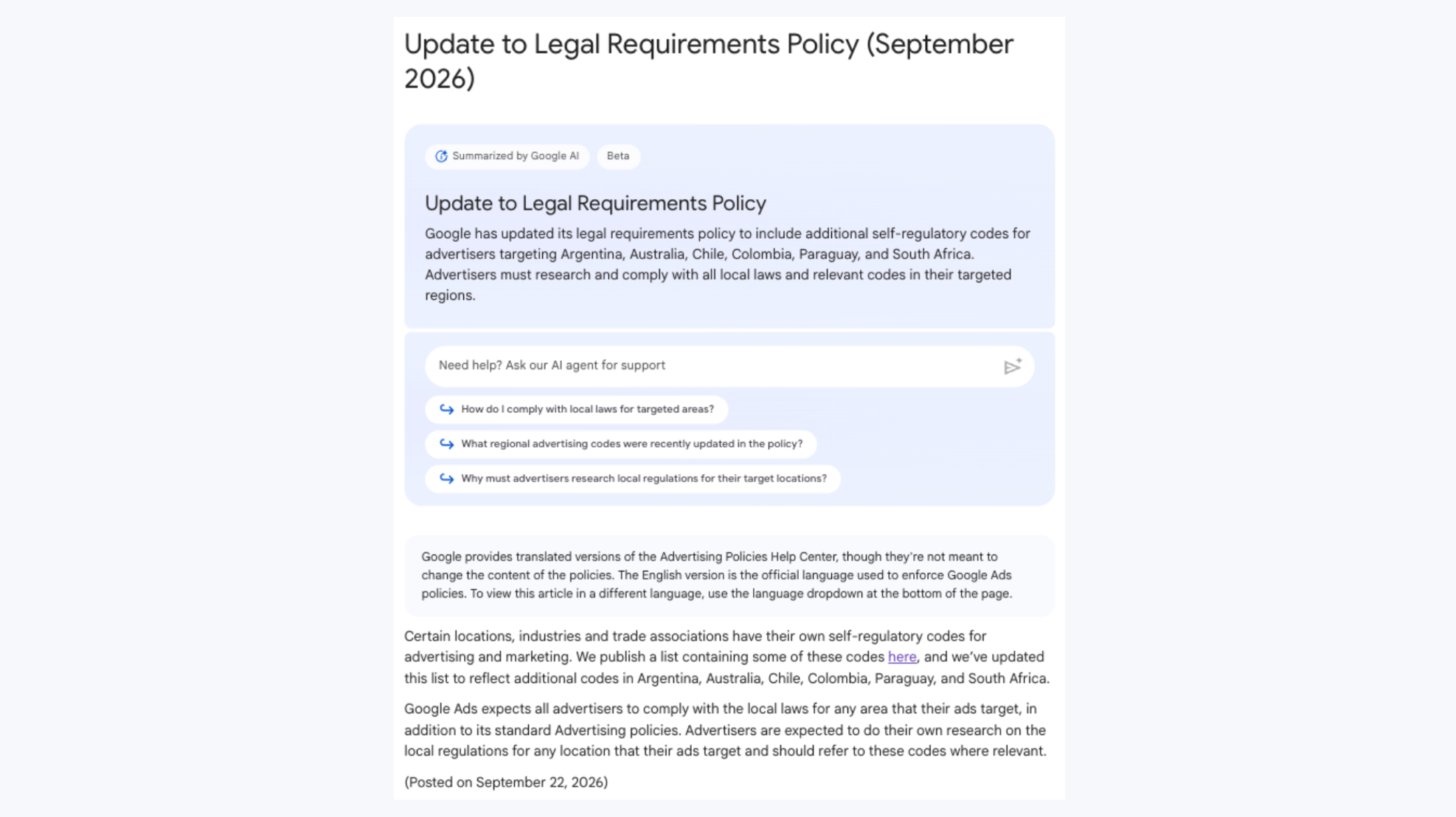
On September 23, Google updated its Legal Requirements policy to say plainly that advertisers are responsible for knowing and following the local laws, industry rules, and trade association codes that apply to their advertising, whether or not Google flags anything. We posted about it that day: see the post
The update matters because approval has been treated as permission. It never was. Google’s review checks Google’s policies. It does not check your state bar’s advertising rules, and it has never claimed to.
For law firms, that gap is where the complaints live. An ad can run for months, spend real money, and be perfectly acceptable to Google while violating the rules that govern the license.
What This Means for Law Firms
Attorney advertising is regulated at the state level, and the rules are specific. Some states require filings or advance review. Some restrict the words “specialist” and “expert.” Some limit testimonials, dramatizations, or claims about past results. Some restrict direct solicitation of accident victims within a set window. A campaign built for a national account can be compliant in one state and a problem in the next.
Google’s policy update does not create those obligations. It removes the excuse. If an ad is not flagged, that means the platform did not catch it, not that the claim is allowed.
The consequence is rarely a suspended account. It is a bar complaint, a competitor’s letter, or an ethics inquiry that arrives long after the campaign ends and forces the firm to reconstruct who approved what. That is a harder problem than a policy violation, because there is no appeal button.
The fix is procedural. Copy gets reviewed against the state rule set before launch, not after. Claims get substantiated or removed. Disclaimers get placed where the rule requires. The approval gets written down, with a name and a date attached.
Our Take
“Slightly annoying” is the right way to describe the update, and so is the rest of what we said: it is our job to know this. Nobody is going to care about a firm’s license except the firm and the people it pays to care. We are one of those.
The uncomfortable part for the industry is that this is not a platform skill. Knowing that a phrase is fine in one state and a violation in another is not something an account manager learns from a certification. It comes from working in one vertical long enough to know where the bodies are buried.
So we treat it as a gate, not a disclaimer. A campaign does not launch until someone has read the copy against the rules and signed off. We would rather miss a launch date than explain to a client why a claim we wrote is now an exhibit.
What ADSQUIRE Is Doing
We are building compliance into the account workflow. That means:
- Reviewing every ad against the firm’s state advertising rules before launch
- Maintaining a working rule set per jurisdiction, updated as bars revise guidance
- Checking claims, superlatives, “specialist” language, and required disclaimers
- Documenting the review with a reviewer, a date, and the version approved
- Coordinating with the firm’s ethics counsel where the rule is unclear
- Training account teams on the vertical, not just the platform
- Flagging the cases where Google’s policy and a state rule point in different directions
For law firms, the standard is not “Google let it run.” It is “we can show why this is allowed.”
Conclusion
Google’s Legal Requirements update puts the burden where it always belonged. Advertisers have to know the laws, industry codes, and self-regulatory rules that apply to what they publish, and a platform’s approval does not transfer that duty anywhere.
For law firms, the stakes are higher than for most advertisers, because the regulator is not Google. It is the bar.
For law firms, competence is a compliance control. The account that knows the rules is the account that does not have to explain itself later.