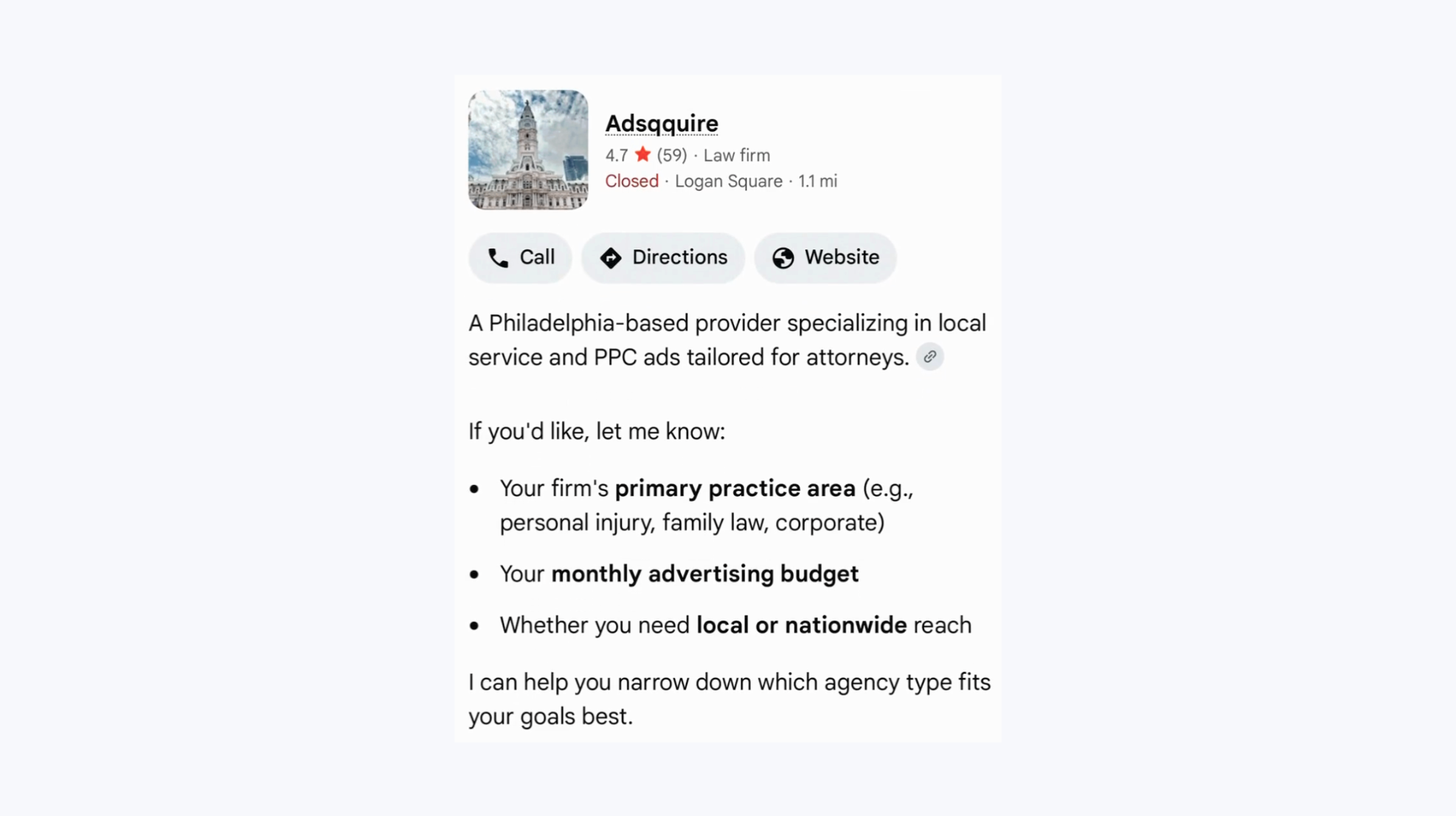
On September 28, Google AI Mode answered a question about legal marketing agencies with a business card for “Adsqquire,” spelled with an extra q, categorized as a “Law firm,” rated 4.7 from 59 reviews, and located in Logan Square. It carried Call, Directions, and Website buttons. Our name was almost right. The rest was somebody else’s information. We posted it that day: see the post
It is the fourth time in three months we have seen it. A listing appears with one brand’s name attached to another business’s phone number, website, category, or address. In one case it was a client’s name pointing to a competitor. In another, a phone number that belonged to a completely different company.
The mechanism is entity resolution at query time. The model assembles a business from scattered sources, and when names collide or attributes overlap, it merges them. What comes out is coherent enough to look like a listing and wrong in the ways that matter.
What This Means for Law Firms
This is a brand hijack, and it is invisible. A person asks who handles a practice area in their city, sees a card with your firm’s name, and taps Call. The call goes to a competitor. You get no impression, no click, and no missed call. The lead never existed as far as your reporting is concerned.
The card can also say things about your firm that are not true. In our case it labeled an advertising agency as a law firm. For a firm, the equivalent is being shown under a practice area you do not handle, with a rating you do not have, at an address you do not use.
That matters beyond lead loss. An AI-generated card is a statement about your business. If it attributes a rating, a location, or a specialty to you, a prospective client will treat it as fact, and the firm will be asked to explain it later.
The scale question is the hard one. Nobody can query every market, every practice area, and every spelling. But when one agency sees four in three months in a single vertical, the base rate is not zero, and the firms seeing it have no dashboard that tells them.
Our Take
Yes, this is happening at scale, and the asymmetry is the point. Generating a plausible listing takes milliseconds. Correcting one takes an entity graph that Google may or may not read.
The defenses are real but partial. Consistent name, address, and phone across every source you control. Structured data on the site. A Business Profile that is accurate to the letter. A brand spelling distinct enough that a model does not fold you into a competitor, or a client, or a practice area. Monitoring, because no one will report this to you.
Then there is the uncomfortable part. There is no guaranteed correction, and no support queue that treats it as a bug. You document it, report it through whatever feedback exists, and watch whether it recurs. A firm that builds its entire lead flow on a surface it cannot correct is taking a risk it has not priced.
What ADSQUIRE Is Doing
We are treating AI answers as a monitored channel. That means:
- Querying AI Mode by market, practice area, and attorney name on a schedule, and capturing screenshots
- Auditing name, address, and phone consistency across the Business Profile, the site, citations, and structured data
- Checking that the site’s schema clearly identifies the business type, location, and services
- Logging every hallucinated listing with the date, the query, and what was wrong
- Reporting each one through Google’s feedback paths and tracking whether it changes
- Keeping intake source capture in place, so leads that never arrived show up as a pattern
- Telling clients plainly that this is a risk they cannot fully control, and what we do about it
For law firms, the goal is not to fix the model. It is to be the version of your firm that is easiest to retrieve correctly, and to know quickly when it is not.
Conclusion
Google AI built a listing with our brand name and another business’s details, and it is not the first time. For law firms, the risk is not a wrong ranking. It is a wrong destination attached to your name.
The workarounds are entity hygiene, monitoring, documentation, and a refusal to depend on one discovery surface. None of them is a guarantee. Together they are the difference between noticing and not.
For law firms, reputation used to be what people said about you. Increasingly it is what a model assembles, and someone has to check.