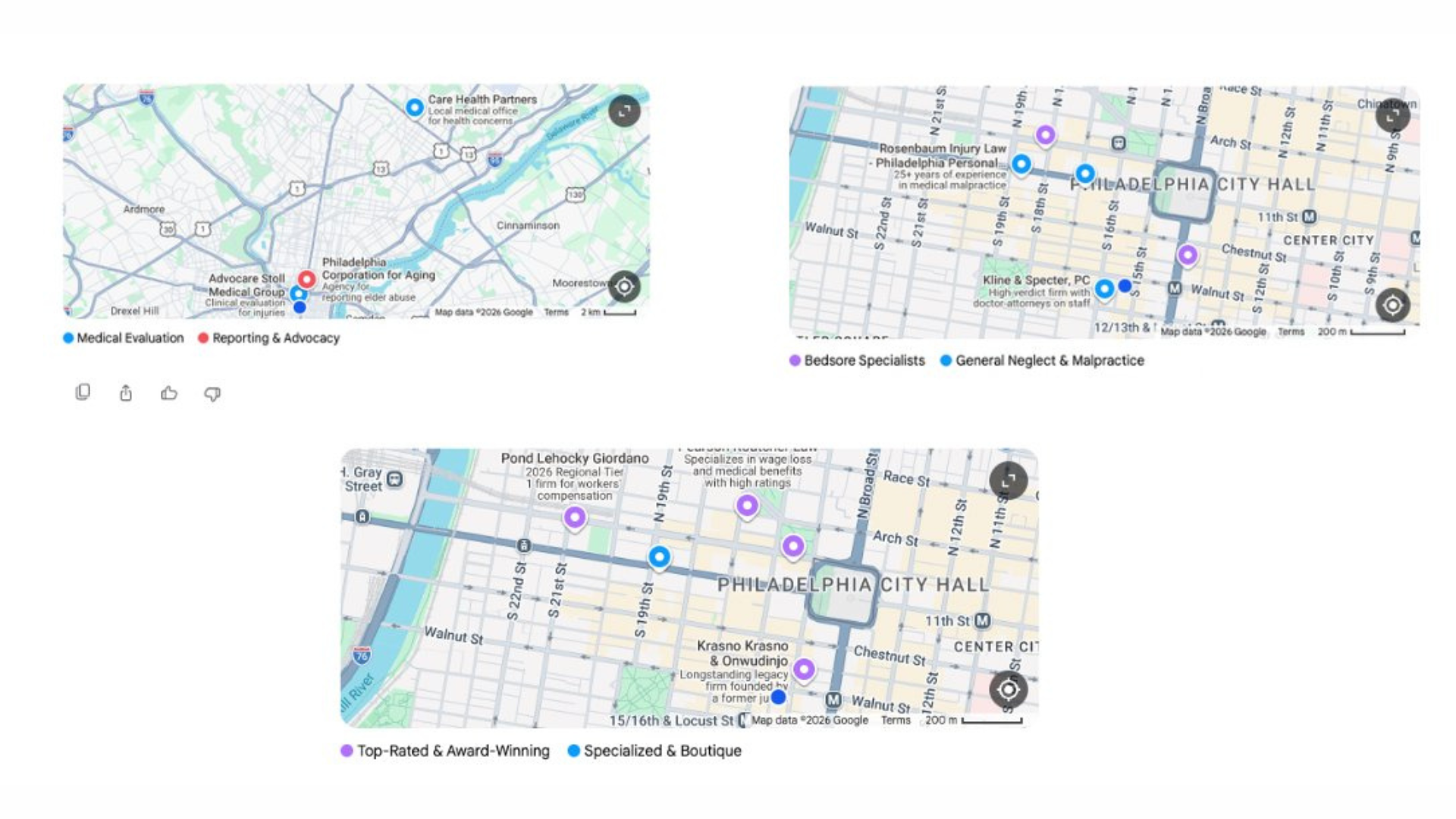
Google is testing a new visual layer inside AI Mode maps—and while it looks like a small design change, it could have meaningful implications for how law firms are discovered.
We’re starting to see different colored pins and geo-based visual groupings across map results. In some cases, the variations appear tied to:
- Business type (e.g., legal vs. other categories)
- Specialization (generalist vs. niche firms)
- Positioning signals like “top-rated” or more boutique-style firms
- Potential regional segmentation or clustering
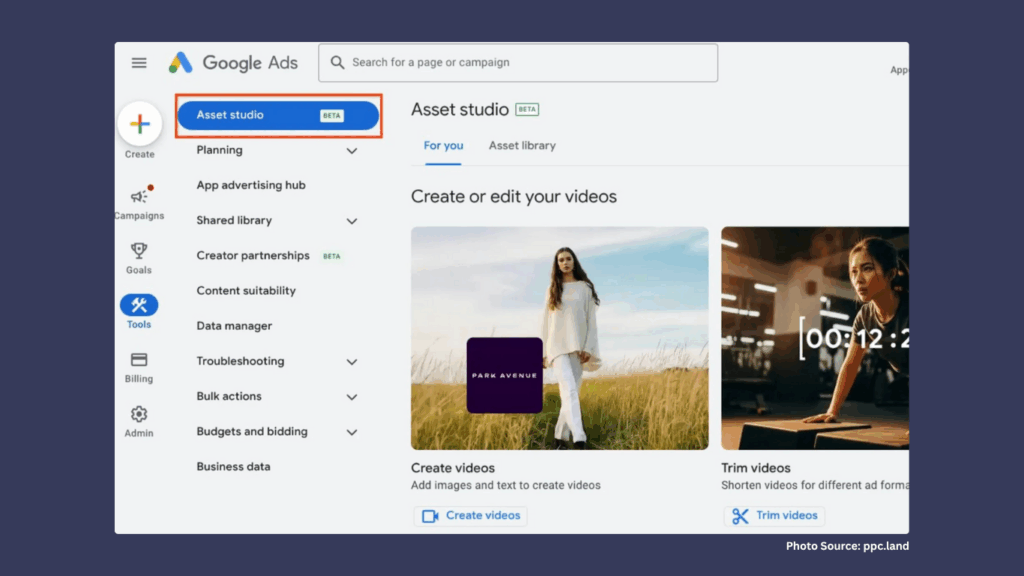
At the same time, this may be connected to Google’s broader push around Demand Gen promoted pins, which leverage existing creative assets and surface businesses across key map environments like Browse, Directions, and place detail views.
Taken together, the map is starting to do more than just show location—it’s beginning to interpret and organize businesses visually.
What’s Changing
Historically, map results were fairly uniform. Every listing looked the same, and differentiation came down to rank, reviews, and proximity.
Now, Google appears to be introducing visual hierarchy directly into the map itself.
Instead of a neutral interface, we’re seeing early signs of:
- Different pin colors signaling different types of businesses or positioning
- Subtle grouping of listings based on shared characteristics
- A shift toward maps that communicate meaning at a glance, not just location
It’s a small UI change on the surface, but it changes how users process results. Rather than scanning line by line, they can quickly form impressions based on visual cues.
Why This Matters for
Law Firms
For law firms, this introduces a new variable into local visibility: how Google categorizes and presents your firm visually.
Users may begin making decisions before they ever click, influenced by:
- Whether a firm appears as a “specialist” vs. a general option
- How it’s grouped among competitors
- What visual signals stand out on the map
If this evolves further, ranking alone won’t tell the full story. Two firms could appear in similar positions but be perceived very differently based on how they’re visually represented.
There’s also a potential paid component here. If this connects to promoted pins through Demand Gen, firms may be able to gain enhanced visibility within these visual layers—but that visibility will likely depend on the strength of underlying assets like imagery and branding.
The Bigger Trend
This fits into a broader shift we’re seeing across Google products.
Search is becoming:
- More visual
- More AI-interpreted
- Less reliant on users reading through structured listings
Instead of presenting options neutrally, Google is increasingly:
- Organizing
- Categorizing
- Guiding decision-making
Maps are starting to reflect that same philosophy. They’re no longer just a tool for navigation—they’re becoming a curated discovery experience.
Our Take
This looks like an early step toward AI-driven positioning inside local search.
Google isn’t just deciding who shows up—it’s starting to shape how businesses are understood.
For law firms, that’s a big deal. Positioning has always mattered, but it was largely controlled through branding, messaging, and reviews. Now, Google may be playing a more active role in defining whether a firm appears:
- Broad vs. specialized
- Premium vs. general
- High-volume vs. boutique
If those signals are being interpreted algorithmically, firms need to be more intentional about the inputs that influence them.
What ADSQUIRE Is Doing
We’re watching these changes closely and starting to map out what drives them.
That includes analyzing how firms are being grouped or color-coded and identifying patterns tied to reviews, categories, and content. At the same time, we’re making sure client profiles clearly reflect their intended positioning—especially when it comes to specialization and service focus.
We’re also monitoring the potential connection to promoted pins and Demand Gen placements, evaluating how paid visibility may intersect with these visual layers.
On the creative side, we’re continuing to strengthen visual assets on Google Business Profiles—because as maps become more visual, first impressions will matter more than ever.
Bottom Line
Color-coded maps may seem like a minor test, but they point to a bigger shift.
Google Maps is evolving into a visually guided decision engine, where classification, presentation, and perception all play a role in who gets chosen.
For law firms, success won’t just come from showing up—it will come from showing up in the right way, with the right positioning, in an environment where Google is increasingly shaping how users interpret what they see.