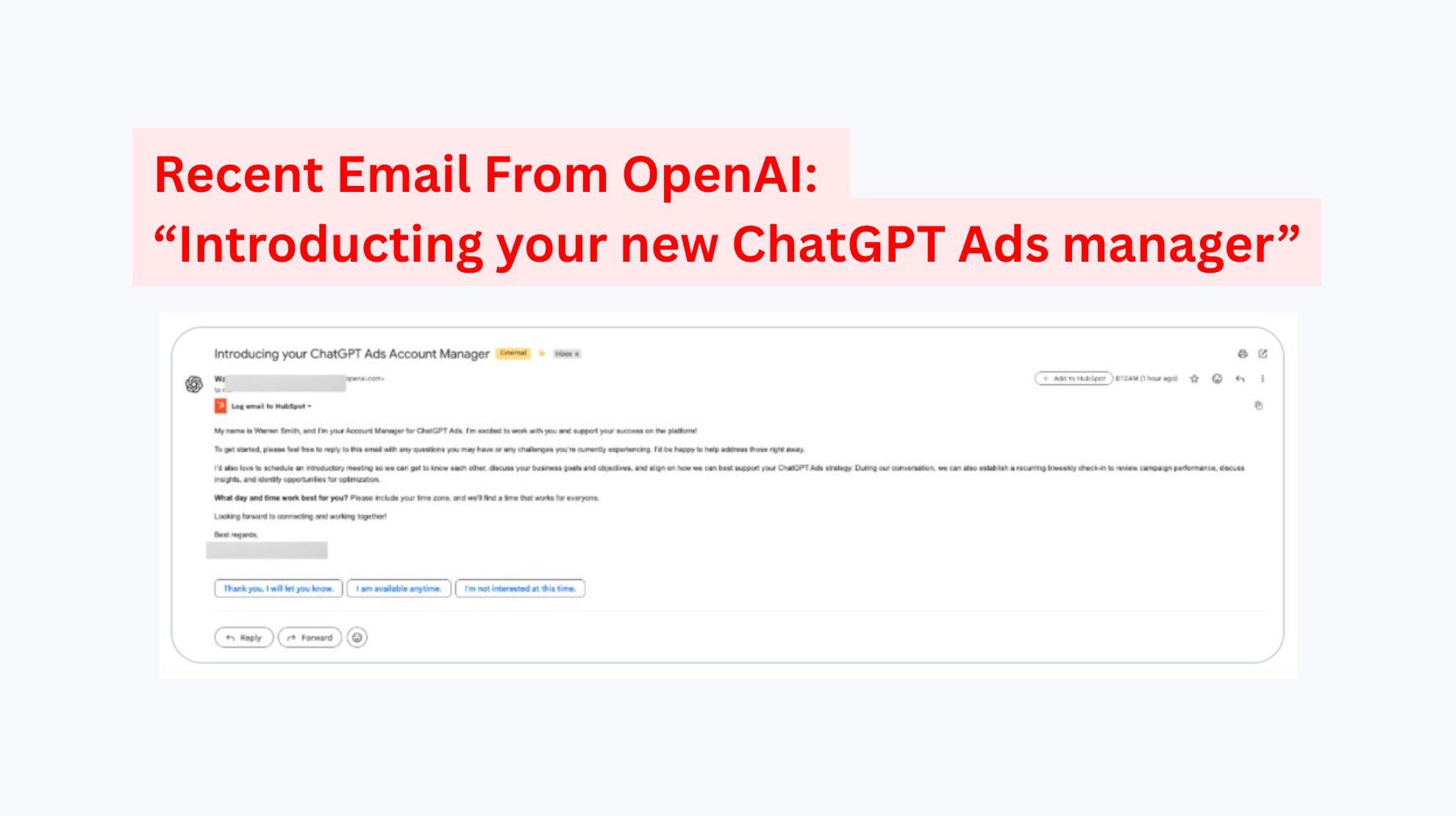
On October 12, an email arrived titled “Introducing your ChatGPT Ads Account Manager.” It introduced a named rep, offered to answer questions, proposed an introductory meeting, and suggested “a recurring biweekly check-in to review campaign performance, discuss insights, and identify opportunities for optimization.” We posted it that day: see the post
The reaction was not enthusiastic. Agencies already sit on calls with Google, with Meta, and now with a platform that has existed for a matter of months, each one wanting a recurring slot on the calendar.
But the email is a signal worth reading carefully. A platform assigns account managers when it has enough revenue to protect and enough advertiser churn to worry about. ChatGPT Ads is moving from experiment to a sales organization.
What This Means for Law Firms
A rep call is not an account review. It is a relationship motion, and the agenda is usually set by the side that scheduled it. If a firm takes the meeting without an agenda of its own, the meeting becomes a budget conversation.
That is not automatically bad. Reps are often the fastest path to information that is not documented: verification timelines, policy interpretation, alpha access to new formats, and answers about why an ad was rejected. In a platform this young, that access has real value.
It also has limits. The rep does not know your state’s advertising rules, will not review your copy against them, and has an incentive to see spend increase. Treat the relationship as a source of information and access, not as a second opinion on compliance or strategy.
There is a practical risk for firms that rely on agencies, too. When a rep calls the client directly and the agency is not in the room, recommendations get made without context. The client hears “increase budget” and not “increase budget after we fix tracking.”
Our Take
We are not going to pretend we enjoy the call volume. Three platforms, three rep cadences, and one calendar is a bad trade for anyone running accounts.
But refusing the calls is also a mistake. In a platform with thin documentation, the rep is often the only human who can confirm how something works. The answer is to control the meeting: come with specific questions, ask for written answers, and leave budget changes out of it.
The firms that benefit from this stage of a platform are the ones that use the access without absorbing the sales motion. Ask for a roadmap, ask for policy clarity, ask for beta access. Do not ask the rep what your budget should be.
What ADSQUIRE Is Doing
We are managing vendor relationships the same way we manage accounts. That means:
- One owner for each platform relationship, so requests and promises do not get scattered
- A standing agenda: documentation gaps, policy questions, verification status, roadmap, and known bugs
- Asking for answers in writing, because verbal guidance does not survive a policy change
- Requesting early access to formats and beta features where they fit a client’s practice areas
- Keeping budget decisions internal, based on lead quality and signed cases
- Tracking what a rep recommends against what it produced, so advice gets evaluated like anything else
- Keeping clients in the loop when a platform contacts them directly
For law firms, the rep is a resource. The strategy still has to come from someone who knows the practice area and the bar rules.
Conclusion
ChatGPT Ads now assigns account managers and wants biweekly check-ins. That is a sign the platform is growing up and a sign that its sales motion has arrived.
For law firms, the value is access: faster answers, earlier features, clearer policy. The risk is letting a sales cadence become the account’s operating rhythm.
For law firms, the calendar is a resource too. Spend it on the calls that change something.