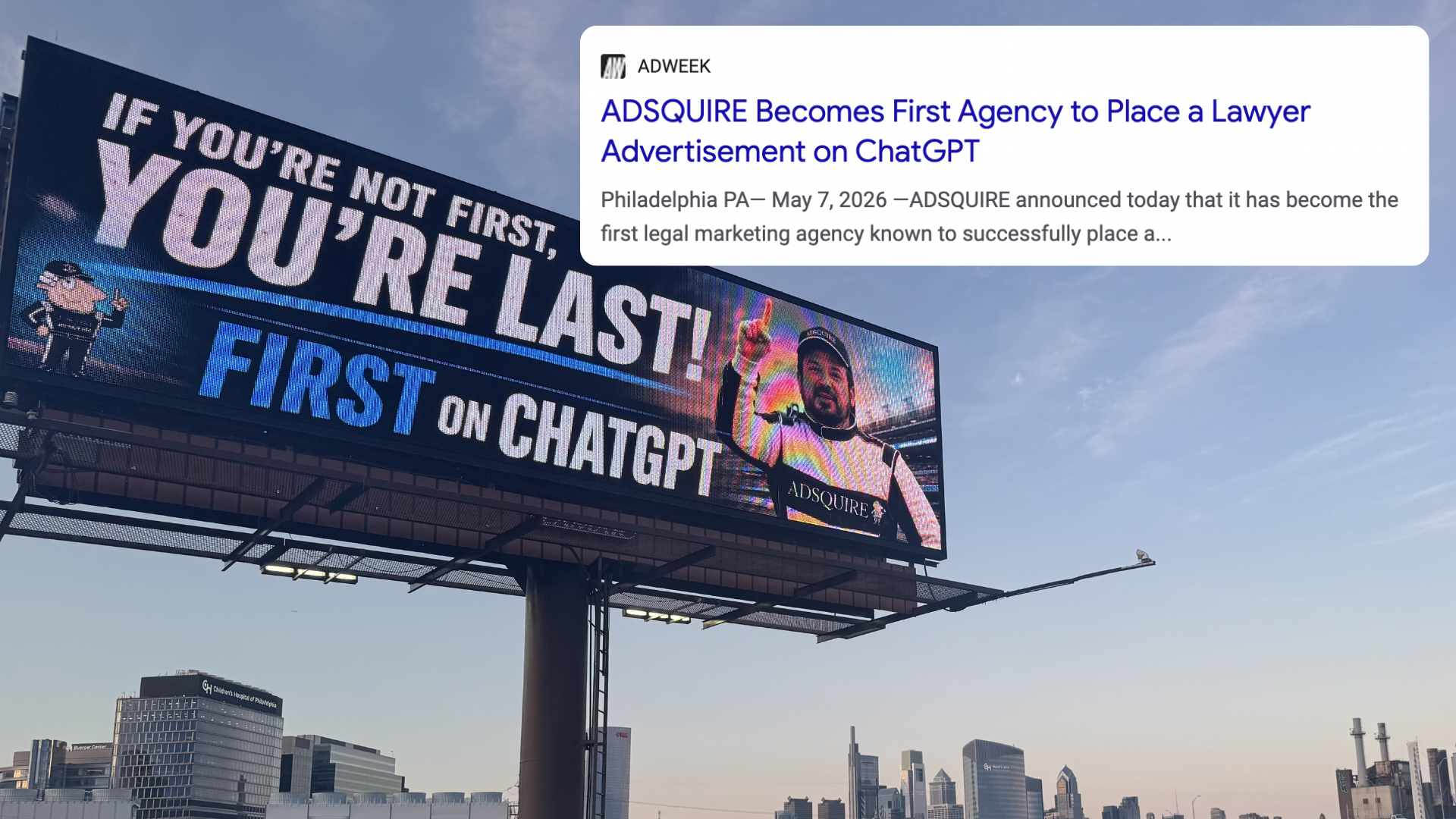
The next major advertising platform is here, and it’s already something millions of people are using daily to ask questions, research major decisions, and increasingly look for professional recommendations: ChatGPT.
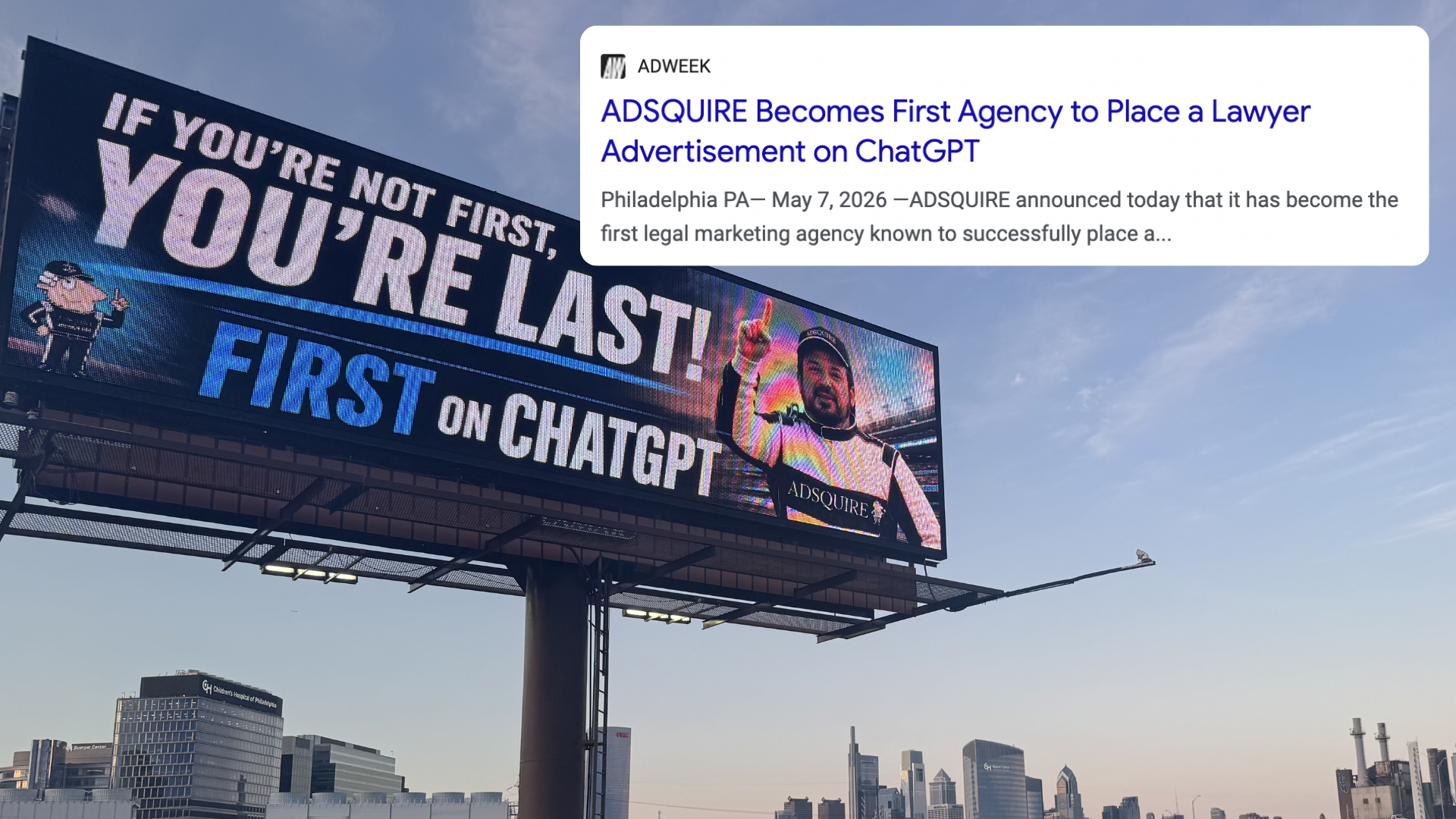
We’ve been actively inside ChatGPT’s advertising rollout from the earliest stages, including ADSQUIRE serving the first-ever legal ad placement inside ChatGPT. Since then, we’ve continued testing as approvals expand, inventory opens up, and the system evolves week to week.
What’s emerging is a new ad platform that’s stripped down, focused on conversational placements, and behaves very differently from Google Ads. Setup is more straightforward than traditional ad platforms, but for law firms there are still real hurdles around verification and sensitive category approval. Even once access is granted, the system itself remains lightweight, fast-moving, and still being actively refined.
Below is a full breakdown of what the platform looks like right now, how it actually works, and how we are getting ads to run for law firms.
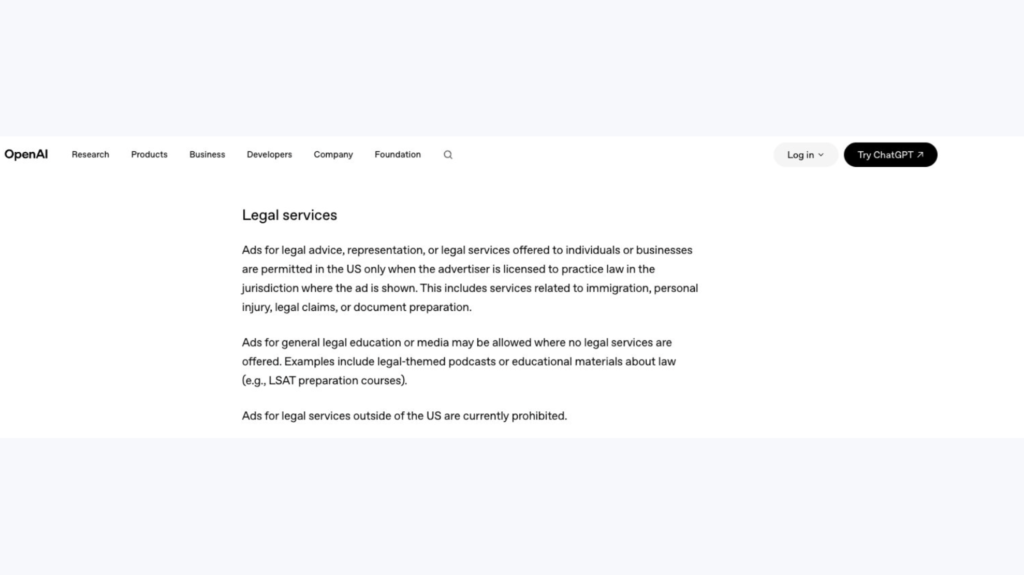
Setup Is Straightforward, But Legal Verification Adds Friction
Getting started inside ChatGPT Ads is relatively simple in structure. Account creation only takes a few minutes, and onboarding is generally quick once approved. That said, for law firms and other regulated categories, the process can include additional review steps that slow initial access.
Sensitive category classification appears to play a role in:
- Whether accounts are approved immediately or held for review
- How quickly ads are allowed to serve after setup
- What creative language is permitted in early testing phases
Once inside, the platform itself is minimal. Compared to Google Ads or Meta, there’s far less structural complexity—fewer layers, fewer settings, and a more guided campaign build.
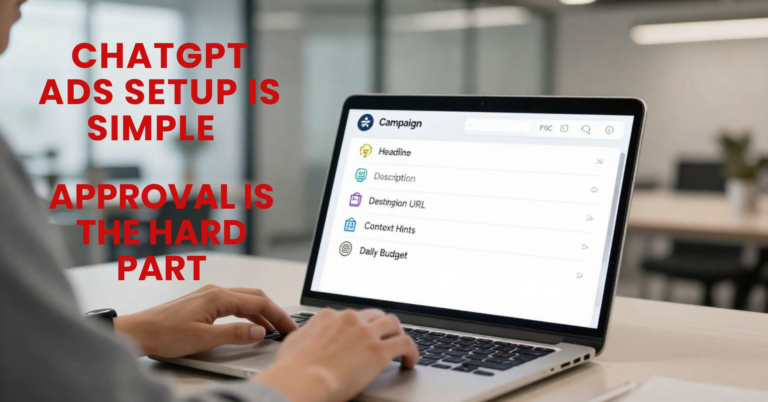
Campaign creation is intentionally simplified:
- One headline (50 characters)
- One description (100 characters)
- A destination URL
- A single image
- Logo set at account level
Best practice for ad copy is still very much in the air, but we are testing variations to see what converts best. ADSQUIRE was also recently given access to a best practices guidelines document directly from OpenAI. Give us a call if you want the sauce.
When it comes to campaign structure, everything is built to reduce setup friction once you’re in—but getting in is still the first real hurdle for legal advertisers.
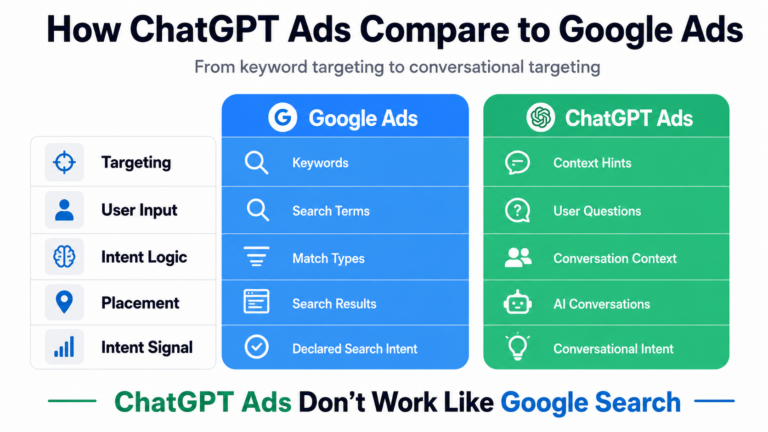
Context Hints In Place Of Keywords
One of the biggest structural shifts is how targeting works.
Instead of keywords, ChatGPT uses what it calls context hints—short descriptions of the types of conversations where your ad should appear. These are not strict rules or match types. They act more like directional guidance for relevance inside conversations.
Advertisers can be broad or specific here, and in some cases, can leave them empty entirely while still getting impressions.
Key points:
- Context hints guide relevance but don’t function like exact targeting
- You’re describing and categorizing query intent, not bidding on terms
- Broader inputs can still surface ads in highly relevant conversations
- Specificity is still being tested heavily across accounts
There’s still a lot of experimentation happening here, especially around how tightly or loosely you can define intent before delivery starts to degrade.
Budgeting and Bidding Are Designed for Simplicity
The system also simplifies spend control in a way that feels closer to early search advertising than modern Google Ads structures.
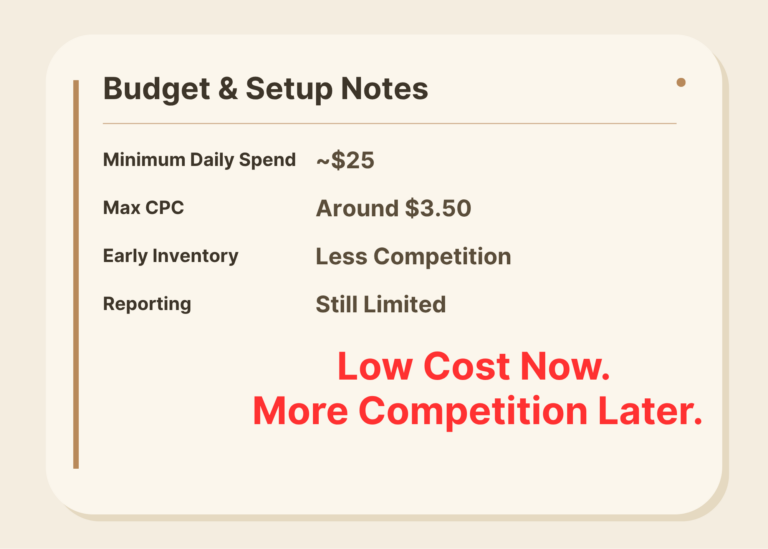
Minimum daily spend sits around $25, making entry accessible even for smaller advertisers testing demand.
On the bidding side, advertisers set a max CPC—typically around the $3.50 range depending on category and approval status.
What’s notable is that costs are still relatively low compared to traditional legal CPCs. That’s less about efficiency and more about where the platform is in its lifecycle. Early inventory, limited competition, and expanding approvals are keeping pricing artificially accessible for now.
Early-stage pricing is still a major advantage—but unlikely to stay that way, so get in as soon as you can.
.Reporting Is Extremely Limited Right Now
This is where the platform diverges most sharply from Google Ads.
There’s no visibility into search terms, conversational prompts, or competitive overlap. Advertisers can’t see what triggered impressions, what competitors were shown, or how users arrived at an ad exposure in detail.
Conversion tracking exists through a snippet system similar to a tag install, but everything beyond that sits inside a black box.
What you get:
- Basic impressions and clicks
- Conversion tracking via pixel/tag
- No query-level transparency
- No competitor or auction insights
We are seeing call tracking platforms like CallRail start to roll out assets designed to track ChatGPT conversions, but it’s still unclear how effectively these will capture conversion data. Stay tuned.
For legal advertisers used to granular control, this is a meaningful shift. You’re optimizing outcomes without full visibility into inputs.

Legal Ads Are Rolling Out, But Still in Controlled Expansion
Availability is increasing quickly, especially over the past few weeks. More verticals are being approved, and real law firm ads are now actively serving—not just testing environments.
However, rollout is still uneven. Some accounts are approved but not serving. Others are serving inconsistently depending on geography, context hints, or creative structure. It seems to vary based on geo and practice area, but we have been able to get personal injury, DUI, divorce, and franchise law ads to serve.
In one of our first successful legal ChatGPT ads, we routed users to a YouTube video instead of a traditional landing page due to how the system marked the websites as a lawyer property (which they are). This allowed ads to serve.
Full site destinations are now serving—but it’s a good example of how early this ecosystem still is.
Creative Restrictions Are More Sensitive Than Expected
One of the most consistent friction points for legal advertisers is copy approval.
Even when accounts are approved, ad copy containing terms like “lawyer,” “attorney,” or certain legal service descriptors can trigger disapprovals. The system appears to be especially sensitive to regulated-service language in early rollout phases.
However, we’re seeing clear workarounds emerge:
- Emphasizing “help,” “support,” or “consultation” language
- Focusing on problem states instead of service labels
- Structuring context hints to carry intent instead of ad copy
- Testing indirect phrasing that avoids regulated keywords
This is still evolving, and what gets approved today may not be what gets approved next month.
Creative flexibility exists—but it’s more about phrasing strategy than direct messaging.
Performance Is Still Cheap, But That Window Is Temporary
Right now, ChatGPT Ads are still in a low-competition phase. CPCs are relatively inexpensive, impressions are easier to access, and there’s less saturation compared to Google or Meta.
That creates a clear opportunity window for early entrants—especially in high-CPC categories like legal.
But the trajectory is obvious. As more advertisers enter, pricing will normalize quickly, and early arbitrage advantages will compress.
The bigger long-term variable is not cost—it’s placement value. Being inside conversational AI at the moment of intent is structurally different from search-based intent capture.
What This All Means for Law Firms
For legal advertisers specifically, ChatGPT Ads introduce a fundamentally different acquisition environment.
Instead of capturing users after they search, ads are being inserted into the conversation itself— in some cases before a traditional Google query ever happens.
That changes a few core dynamics:
- Intent is interpreted, not declared
- Exposure happens earlier in the decision process
- Traditional keyword control doesn’t apply
- Messaging clarity matters more than exact match targeting
At the same time, reporting limitations mean firms need to be comfortable operating with less visibility than they’re used to in Google Ads.
What ADSQUIRE Is Doing
We’re treating ChatGPT Ads as a parallel testing environment to search, not a replacement. But it does pose as one of the most exciting developments in the digital marketing space in a long time.
Current focus areas:
- Running controlled legal tests as approvals expand
- Mapping which context hint structures actually trigger delivery
- Stress-testing creative compliance boundaries for PI messaging
- Tracking real conversion quality vs. platform-reported signals
- Monitoring shifts in eligibility across legal subcategories
We’re also continuing to prioritize what has always mattered most in legal acquisition: case quality, intake consistency, and downstream conversion—not just early-platform performance metrics.
Bottom Line
ChatGPT Ads are still early—but they’re not experimental anymore in the traditional sense. Real law firm ads are live, budgets are active, and inventory is expanding quickly.
The system is simple on the surface, but structurally significant underneath it. It removes layers of complexity while introducing new constraints around visibility, targeting logic, and reporting transparency.
For law firms, the opportunity right now is straightforward: get in early, learn how context-based targeting behaves, and build a framework for conversational intent before competition and pricing catch up.
Because once they do, this channel stops feeling new very quickly.
If you want to get ChatGPT Ads up and running, call the legal ad pros at ADSQUIRE today.