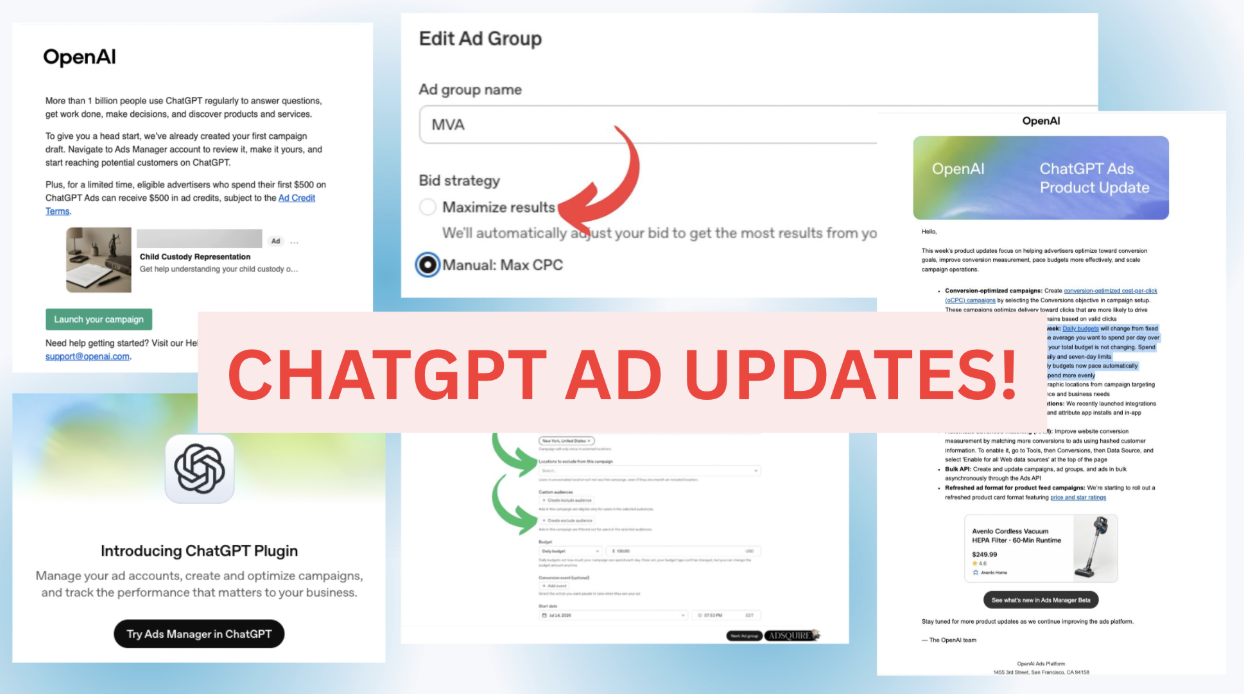
ChatGPT advertising is moving fast.
For law firms and legal marketers, that creates both an opportunity and a headache. OpenAI is continuing to build out its advertising platform, adding features that look increasingly familiar to anyone who has spent years working in Google Ads and other mature paid media platforms.
Over the past several weeks, we’ve seen significant changes to everything from targeting and tracking to budgets, bidding, ad policies, and even where ads can appear.
Some of these updates are genuinely useful for legal advertisers. Others are still rough around the edges. And a few are changes that law firms should understand before putting serious money into the platform.
Here are 11 of the biggest recent ChatGPT Ads updates and what they mean for law firms.
1. ChatGPT Ads Added a “Duplicate Ad” Feature
One of the newest quality-of-life improvements is the ability to duplicate an ad.
This might sound minor, but anyone managing paid search campaigns knows how useful a simple duplication feature can be. Rather than rebuilding an ad from scratch, advertisers can now duplicate an existing one and make the necessary changes.
For law firms, this can become particularly useful when testing variations of messaging.
For example, a personal injury firm might want to test:
- “Injured in a Car Accident?”
- “Hurt in a Car Crash? Know Your Rights.”
- “Speak With a Car Accident Attorney Today.”
Duplicating an existing ad makes those tests considerably easier to build and manage.
The feature isn’t available in every account yet, and there are still some obvious campaign-management features missing. Campaign and ad group duplication would be the logical next additions.
That matters because legal advertising accounts can become complicated quickly. A firm may have separate campaigns for car accidents, truck accidents, motorcycle accidents, premises liability, wrongful death, and other practice areas.
The easier ChatGPT makes it to replicate campaign structures, the more practical the platform becomes for serious advertisers.
2. Audiences and Advanced Bid Adjustments Are Here
ChatGPT Ads has also started rolling out audience targeting and advanced bid adjustments for audiences.
This is a significant development for the platform because audience controls give advertisers another layer of control over who sees their ads.
For legal advertisers, however, the immediate impact is somewhat limited.
Most law firms aren’t selling products that naturally lend themselves to conventional audience segmentation. A personal injury attorney doesn’t necessarily want to target a particular demographic simply because that demographic is more likely to click an ad.
Search intent is still the big one for legal.
Someone asking ChatGPT:
“What should I do after being hit by a drunk driver?”
is much more valuable to a personal injury firm than someone who simply falls into a particular demographic audience.
That said, audiences could become much more interesting as ChatGPT Ads matures.
For example, firms could eventually have opportunities to adjust bids based on different types of users or behavioral signals. The value of that will depend heavily on what additional audience data OpenAI makes available.
For now, it’s a feature to watch rather than a reason for a law firm to completely rethink its advertising strategy.
3. Geo Exclusions and Audience Exclusions Have Been Added
This is a much more immediately useful update for law firms.
ChatGPT Ads now includes geo exclusions and audience exclusions.
Geographic control is particularly important in legal advertising because attorneys are generally limited to specific jurisdictions.
A Philadelphia personal injury firm doesn’t want to spend money showing ads to someone in California. A Texas family law firm doesn’t need impressions from users halfway across the country.
Being able to exclude locations helps prevent wasted spend.
It also becomes increasingly important as law firms expand their ChatGPT advertising campaigns.
Imagine a firm advertising throughout Pennsylvania but specifically not wanting traffic from certain areas because it doesn’t have an office, doesn’t accept cases there, or has another marketing strategy in that market.
Geo exclusions give advertisers another tool for managing that.
For legal marketers, this is one of the more meaningful targeting improvements we’ve seen.
Audience exclusions can also become useful as the platform develops. The more control advertisers have over who doesn’t see an ad, the easier it becomes to keep campaigns focused.
4. UTM Tracking Is Now Available at All Levels
Another major improvement for advertisers is the addition of UTM parameters across all levels of ChatGPT Ads.
For anyone running serious paid media, this is a big deal. UTMs allow advertisers to pass campaign information into their analytics and CRM systems, making it easier to determine where a lead originated.
Now, that’s particularly important for law firms. A legal marketing campaign shouldn’t be judged simply by:
- Impressions
- Clicks
- CTR
- CPC
The real question is:
Did the advertising generate a qualified potential client?
A properly tracked ChatGPT Ads campaign can eventually be tied into the broader lead-tracking infrastructure that many law firms already use.
That can mean connecting ChatGPT traffic to systems such as:
- Google Analytics
- CRMs
- Call tracking
- Lead management platforms
- Marketing reporting platforms
For agencies managing multiple law firms, standardized UTM tracking is also critical because it makes it much easier to separate ChatGPT traffic from Google, Microsoft, Meta, and other channels.
As ChatGPT Ads become a larger part of a firm’s advertising make-up, attribution is going to matter more and more.
5. OpenAI Updated Its Health and Financial Advertising Policies
This is one of the updates legal advertisers should pay especially close attention to.
OpenAI recently updated its advertising policy documentation around health and financial services, providing additional clarification around eligible categories and markets.
Certain services in these areas may now be eligible on a case-by-case basis, depending on the specific service and market.
Why does this matter to law firms?
Because the regulatory and policy environment around advertising is particularly sensitive when an advertiser operates in a regulated or high-stakes industry.
Legal services sit in a similar category of advertising where platform policies, jurisdictional restrictions, and the specific language used in an advertisement can all matter.
This is also a good reminder that ChatGPT Ads policies are not static. Something that isn’t eligible today may become eligible tomorrow. Something that is permitted today could potentially receive additional restrictions later.
Law firms should therefore avoid treating the initial ChatGPT Ads policy as a permanent rulebook- the platform is still being built.
6. ChatGPT Ads Changed How Budgets Work
Here’s one of the updates advertisers are likely to notice immediately.
ChatGPT Ads has moved toward a weekly approach to daily budgets.
Instead of thinking of the daily budget as a strict amount the platform will spend every single day, advertisers should now think about it more like a seven-day average.
That should sound familiar to Google Ads advertisers.
Under the new approach, ChatGPT can spend more than the stated daily budget on a particular day when there is an opportunity to generate results, while balancing that spending across the seven-day period.
For example, if an advertiser sets a $25 daily budget, ChatGPT may spend more than $25 on one day while spending less on another day.
The important part is the seven-day average, rather than treating the daily figure as an absolute daily spending ceiling.
Why this matters for law firms
Legal advertisers need to pay attention here because many firms operate with relatively tight budgets.
If you’re testing ChatGPT Ads with a small budget, daily fluctuations can make the campaign look more volatile than expected.
And there’s another important consideration:
The current minimum budget is roughly $25 per day, or about $760 per month.
That means ChatGPT Ads isn’t necessarily a platform where a law firm can casually throw $5 or $10 per day at a test.
For a firm spending thousands of dollars per month across Google Search, LSAs, and other channels, $760 may be manageable.
For a smaller firm, it’s a much bigger commitment.
7. The New Budget System Can Spend Up to 2X the Daily Budget on a Given Day
OpenAI’s communication around the budget change provided additional clarification.
Under the new system, the platform can spend up to twice the daily budget on a given day, while still targeting the seven-day average.
Again, this is similar to the way Google Ads has historically handled daily budgets, and it isn’t necessarily a bad thing. If ChatGPT identifies a day with particularly strong advertising opportunities, allowing the system to spend more could potentially help advertisers capture additional conversions.
But for law firms, cash-flow and budget planning become more important.
If a firm has allocated exactly $760 for its ChatGPT Ads test, it shouldn’t assume that means exactly $25 will leave the account every day.
The seven-day budgeting model needs to be accounted for when planning spend.
8. OpenAI Introduced a ChatGPT Ads Manager Plugin
OpenAI has also introduced a ChatGPT Ads Manager plugin.
The concept is interesting: advertisers can manage aspects of their advertising activity through ChatGPT itself rather than relying exclusively on the traditional advertising interface.
The idea is familiar to anyone who has worked with Google’s various advertising tools and integrations.
Whether advertisers actually adopt this heavily remains to be seen.
There is also a bigger issue right now: ChatGPT Ads is changing extremely quickly.
With so many features being added, modified, and tested at the same time, advertisers are encountering bugs, disapprovals, inconsistent ad serving, and other strange behavior.
That’s something law firms need to take seriously. A campaign not serving doesn’t necessarily mean the strategy is bad- sometimes the platform itself is still figuring things out.
For that reason, we wouldn’t recommend that a law firm move a huge percentage of its advertising budget into ChatGPT overnight, but rather test it. Watch it. Track it. Then scale it when the data justifies scaling.
9. “Maximize Results” Bidding Has Started Appearing
Another familiar feature has started appearing in ChatGPT Ads: Maximize Results bidding.
This is an automated bidding strategy designed to let the platform make more of the bidding decisions on the advertiser’s behalf.
For advertisers coming from Google Ads, this concept isn’t exactly revolutionary, but ChatGPT Ads is still a very young advertising platform- and that’s an important distinction. Automated bidding strategies tend to become more useful as platforms accumulate more conversion data.
For a law firm launching its first ChatGPT campaign, there may not be enough historical data to justify handing over significant control to an automated strategy.
At least initially, manual control can be valuable simply because we’re still learning how the platform behaves.
That doesn’t mean automated bidding won’t eventually become extremely effective (it probably will), but legal advertisers should be careful about assuming that a feature being labeled “Maximize Results” automatically means it will produce the best results.
The algorithm needs data.
10. Advertisers Can Now Choose Where Their Ads Appear
ChatGPT Ads has also added another useful control:
Advertisers can select the platforms on which they want to serve ads.
The current options include:
- iOS app
- Android app
- Web
This may seem like a relatively small addition, but platform-level controls can become extremely valuable when advertisers start seeing meaningful differences in performance.
For example, imagine a law firm eventually discovers that:
- Web users convert at 8%
- iOS users convert at 4%
- Android users convert at 2%
Being able to control those placements would give advertisers another way to manage efficiency.
We’re not necessarily at the point where law firms have enough data to make sweeping decisions about iOS vs. Android vs. web. But that’s exactly why having control is important. The platform is giving advertisers more levers to pull.
And as more data accumulates, those levers become more useful.
11. ChatGPT Ads Are Offering Free Ad Credits
And finally, one of the most interesting developments for advertisers:
OpenAI has begun offering promotional ad credits.
If you’ve been considering testing ChatGPT Ads, this is worth paying attention to.
There have been promotional offers providing advertisers with free advertising credit, making it possible to test the platform without putting the entire initial investment on the firm’s dime.
One strategy worth considering is creating an advertising account even if you aren’t ready to launch immediately. Promotional offers may be sent to eligible accounts that have not yet started spending.
For a law firm or agency that’s curious about ChatGPT Ads, that’s potentially a very inexpensive way to get initial data.
And honestly, law firms should be testing this now rather than waiting until ChatGPT Ads become completely mature.
The early stage of a new advertising platform is when advertisers have the opportunity to learn how it works before competition catches up.
What All of These Updates Mean for Law Firms
Taken individually, some of these changes may not seem particularly significant.
Put them together, though, and there’s a much bigger story.
ChatGPT Ads is starting to look more like a real advertising platform.
We’re seeing the pieces that experienced PPC advertisers expect:
- Audience targeting
- Geographic controls
- Exclusions
- UTM tracking
- Automated bidding
- Budget management
- Placement controls
- Ad duplication
- Advertising management tools
- Promotional credits
That’s important for law firms because legal advertising is one of the industries where intent matters enormously.
Someone asking ChatGPT about a potential legal problem is fundamentally different from someone casually browsing social media.
Consider the difference:
“What are some things I can do this weekend?”
versus:
“I was injured in a car accident and the insurance company is refusing to pay. What are my options?”
The second conversation contains an incredibly strong signal.
That doesn’t mean every ChatGPT user asking a legal question is ready to hire an attorney, but it does mean that ChatGPT has the potential to become an increasingly important environment for high-intent discovery. That’s what makes these advertising developments worth watching.
The Biggest Opportunity May Not Be Here Yet
The most interesting part of ChatGPT Ads right now isn’t necessarily any one of these features, rather it’s the direction the platform is moving.
OpenAI appears to be building many of the same controls that advertisers have come to expect from mature advertising ecosystems. At the same time, the platform has something Google doesn’t have in quite the same way:
A massive amount of conversational context.
People don’t just search ChatGPT with two or three keywords. They explain situations, ask follow-up questions, describe problems, compare options, and ask for recommendations.
For legal marketers, that could eventually create some very interesting opportunities.
Imagine being able to reach someone at the point where they’re having a conversation about whether they need a lawyer, what type of lawyer they need, or what happened in their particular situation. That’s a fundamentally different advertising environment from traditional keyword search.
We’re not saying ChatGPT Ads has completely solved that yet. It hasn’t. The platform is still young, and there are plenty of bugs, inconsistencies, and unanswered questions. But the trajectory is becoming increasingly difficult to ignore.
Should Your Law Firm Be Advertising on ChatGPT?
For most law firms, the answer right now probably isn’t to move your entire Google Ads budget to ChatGPT. It’s also not “ignore it until it gets bigger.” The smarter approach is somewhere in the middle.
Test it.
Start with a controlled budget. Track everything. Pay attention to which types of queries and conversations generate meaningful traffic. Watch lead quality, not just clicks.
And most importantly, don’t evaluate ChatGPT Ads using the same assumptions you use for traditional search. The platform is different, the user behavior is different, and the advertising ecosystem is still developing.
Law firms that start learning how it works now will have an advantage over firms that wait until ChatGPT Ads becomes another crowded, expensive advertising channel.