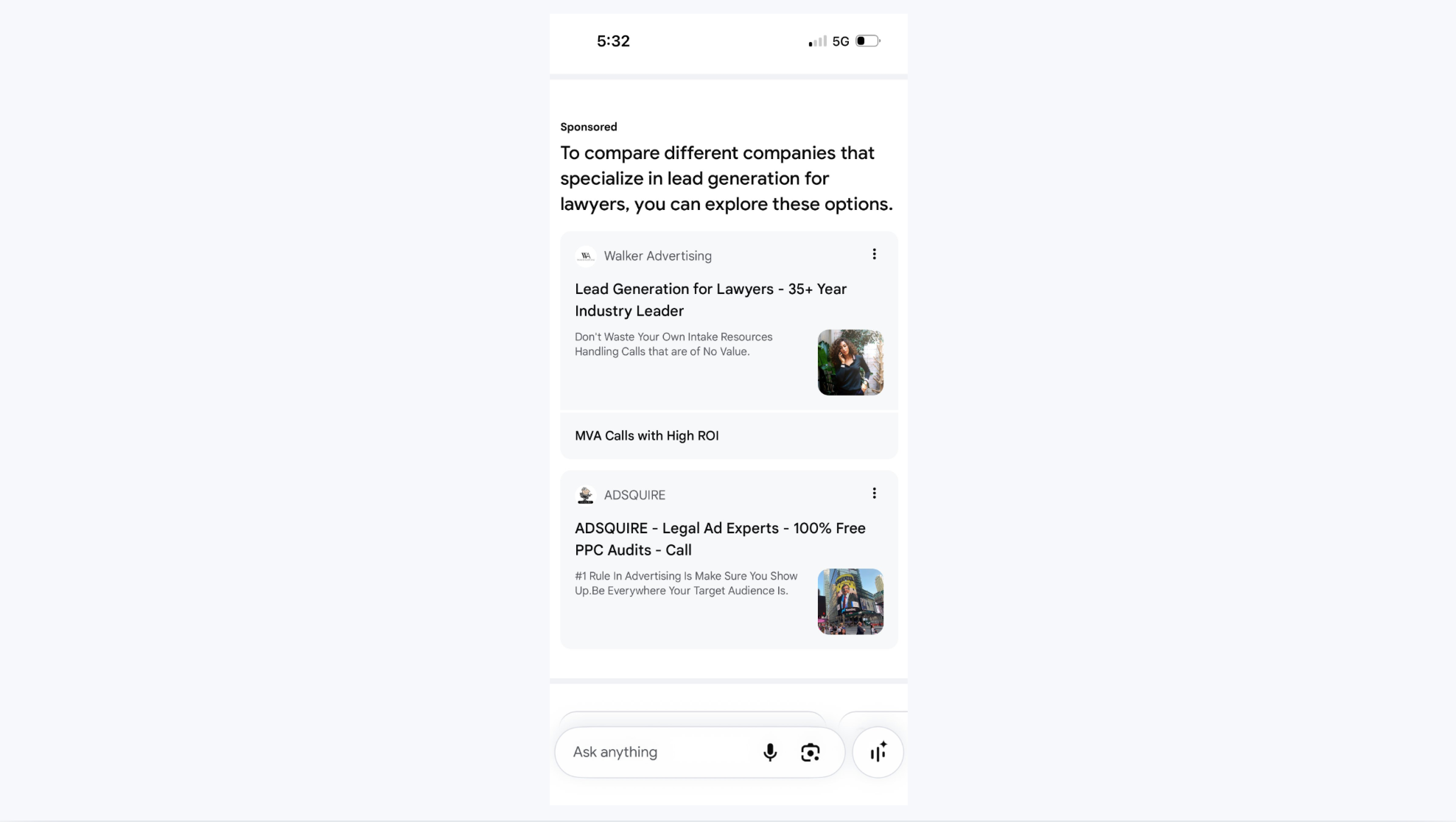
On September 30, an AI Mode sponsored block for a legal lead-generation query showed two ad cards built out with thumbnails, headlines, descriptions, and a sitelink row beneath. One card carried “MVA Calls with High ROI” as a second clickable line. We posted it that day: see the post
That is a small visual change with a clear meaning. A card with one link is a placement. A card with a thumbnail, a headline, a description, and sitelinks is a structured ad unit, the kind of thing a platform builds when it expects the format to stay.
For law firms, the consequence is straightforward: more real estate on a surface most firms have not tested, and more ad copy that has to be right.
What This Means for Law Firms
Every clickable line in an ad is a claim. A sitelink is short by design, so it carries no room for context, conditions, or the disclaimer that made the headline accurate. “Free consultation” is a different statement from “free consultation for new personal injury matters in Pennsylvania,” and the sitelink is the one that travels.
That matters because legal advertising rules apply line by line. Model Rule 7.1 governs the communication, not the headline alone. A sitelink promising a result, a fee outcome, or a specialty the firm does not hold is a problem whether it appears in Search or inside an AI Mode card.
There is a new wrinkle in this surface. AI Mode ads are young, reporting is thin, and it is not always clear where a sitelink comes from. Some will be assets you wrote. Some may be drawn from your site. A firm that has not audited its own pages should assume the second category exists.
The upside is real. Sitelinks give a prospect a specific next step, which is exactly what a legal ad needs. “Free case review” beats “learn more” for someone deciding who to call.
Our Take
The format expansion is the story, not the sitelink. Google is building AI Mode ads into a full product, and it is doing it while the inventory is still cheap and the competition is thin. That is the window where testing is worth it.
We would rather write three boring, accurate sitelinks than one clever one. “Offices in Center City and King of Prussia.” “Spanish-speaking intake.” “Free consultation, no obligation.” Each is checkable, each is useful, and none of them creates a claim we have to walk back.
What we will not do is port a Search sitelink set into AI Mode without review. Different surface, different presentation, same rules, and no reporting yet to tell us which line did the work. That combination rewards discipline more than cleverness.
What ADSQUIRE Is Doing
We are treating AI Mode as a test channel with compliance gates. That means:
- Auditing sitelink assets for accuracy, fee language, and state-specific disclosure rules before they run
- Keeping sitelinks specific to practice area, office, and language rather than vague calls to action
- Checking whether sitelinks are being pulled from site content we do not control
- Testing one variable at a time, since AI Mode reporting is too thin for multi-variable reads
- Tracking clicks by UTM and landing page so we can tell which line produced the call
- Comparing AI Mode lead quality against Search and Local Services before scaling budget
- Documenting what the format looks like each month, because it is changing fast
For law firms, the goal is not to be first in a new format. It is to be correct in it.
Conclusion
AI Mode ads are gaining sitelinks and thumbnails, which is what a maturing ad product looks like. For law firms, that means more ways to earn a click and more lines that can be wrong.
The compliance standard does not relax because the surface is new. If anything, a format with thin reporting and fast iteration needs more review, not less.
For law firms, every line in the ad is the ad. Write the ones you can defend.