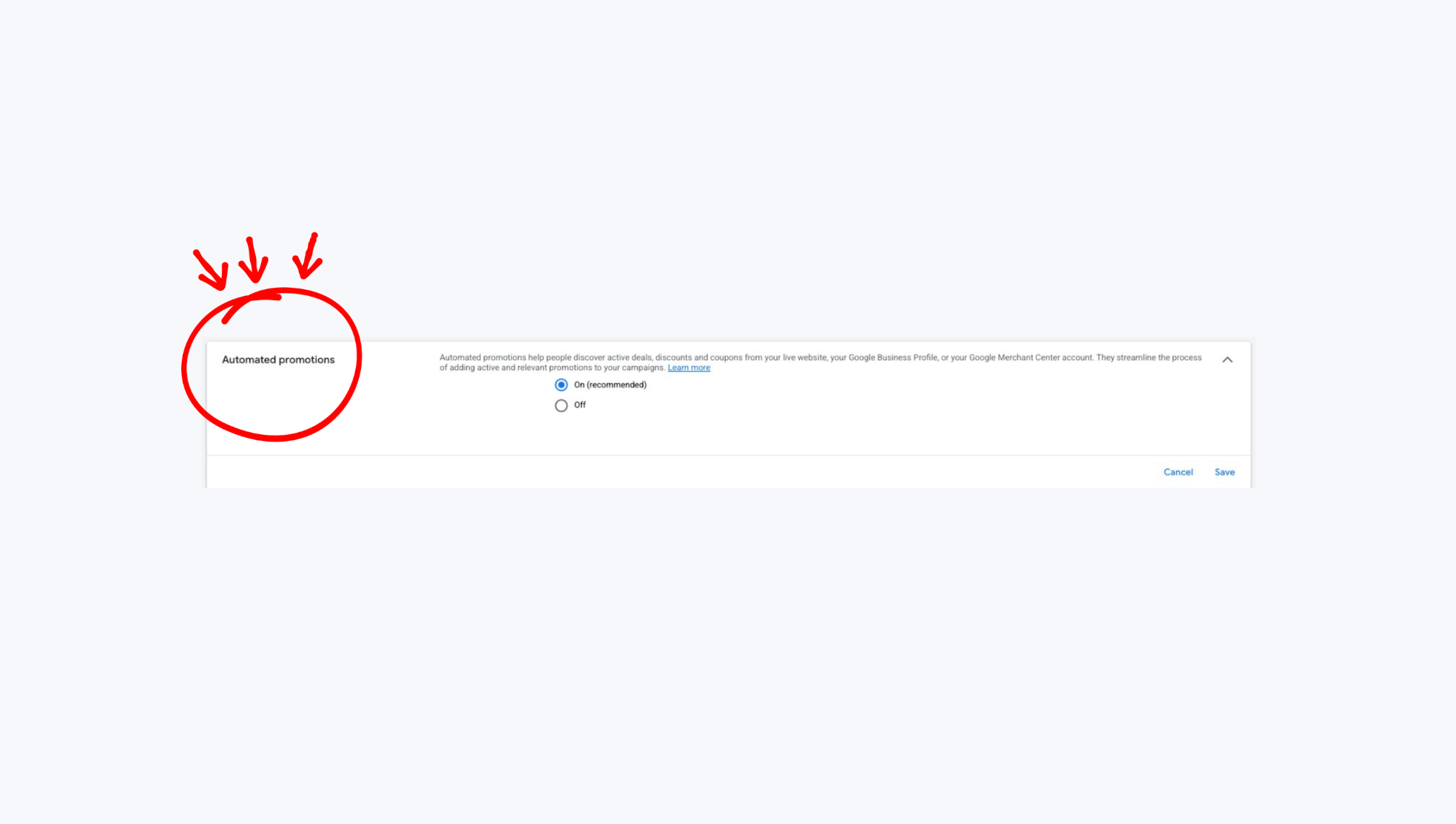
On September 23, a new account-level setting started appearing in Google Ads accounts: Automated promotions, already switched to “On (recommended).” The description says Google will identify deals, discounts, and coupons from your website, your Google Business Profile, or your Merchant Center account and add them to your campaigns. We posted about it that day: see the post
The mechanics are narrow but the reach is not obvious. Only Search and Performance Max campaigns with location assets and no manual promotion of their own are eligible. Google says each extracted promotion serves for under 24 hours and is renewed only while the system can still see the offer on your site. Assets added this way are labeled “Google AI” in the Added by column.
Google then emailed advertisers in early October to say the setting would be on by default from October 12. It has been live since. The off switch is buried: Assets, the three-dot menu in the filter bar, Account level automated assets, another three-dot menu, Advanced settings, then Automated promotions.
What This Means for Law Firms
Legal websites are full of offer language. Free consultation. No fee unless we win. Percentage fees. Case evaluations. Most of it is intentional and accurate. Some of it is a banner on a page from 2023 that nobody took down, or a blog post about a settlement that reads like a deal.
An extraction system does not know the difference between a current offer and a stale one. It reads the page. If the page still says it, the ad can still run it.
That is the compliance problem. A promotion asset is not a reviewed copy. It is a line lifted from your site and attached to your ad, and it is still your advertisement. Model Rule 7.1 does not care that a machine assembled the sentence. Neither does a state bar that requires fee claims to be explained, or one that restricts how “free” can be used when conditions apply.
The conditions rarely travel. A promotion asset is short. It will not carry the eligibility rules, the jurisdiction limits, or the disclosure that made the original offer accurate.
Our Take
For most law firms, this feature solves a problem they do not have. Legal services are not retail. Firms do not run coupons, and the closest thing to a deal is a fee structure that has to be described carefully. Google built retail tooling and pointed it at every advertiser with a location asset.
The default is the recurring issue. This is the third automation in a year that arrives switched on and described as recommended, each one adding content to ads that a firm did not write. The pattern is consistent enough to plan around: assume anything labeled recommended is on, and audit quarterly.
Our default is off. Where a client has a genuine, reviewable offer, we will build it manually so we control the wording, the dates, and the disclosure. That is slower. It is also the only version we can defend.
What ADSQUIRE Is Doing
We are treating this as an account-level audit item. That means:
- Checking the Automated promotions setting in every account, since the default-on date has passed
- Switching it off for legal campaigns unless a client has a real, reviewed offer
- Sweeping client sites for stale banners, old promo pages, and fee language that could be extracted
- Building manual promotions for genuine offers, with dates and terms attached
- Filtering Assets by Promotion to catch any “Google AI” rows that appear
- Reviewing anything auto-added against the firm’s bar rules before it keeps running
- Documenting the setting and the decision for each client, with a date
For law firms, the goal is not to ban promotions. It is to make sure the only offer in your ad is one your firm wrote and approved.
Conclusion
Google’s Automated promotions setting has been on by default since October 12, pulling offer language from websites, profiles, and feeds into eligible campaigns. For law firms, the risk is not the feature itself. It is the sentence it might lift from a page nobody has read since it was published.
The fix is small and unglamorous. Check the setting, turn it off where it does not belong, and clean the pages it reads. Then decide, deliberately, whether any real offer is worth running.
For law firms, an ad is a communication about the firm. It does not matter who assembled it.