A new Local ad format is making something very clear: clickable assets are taking center stage.
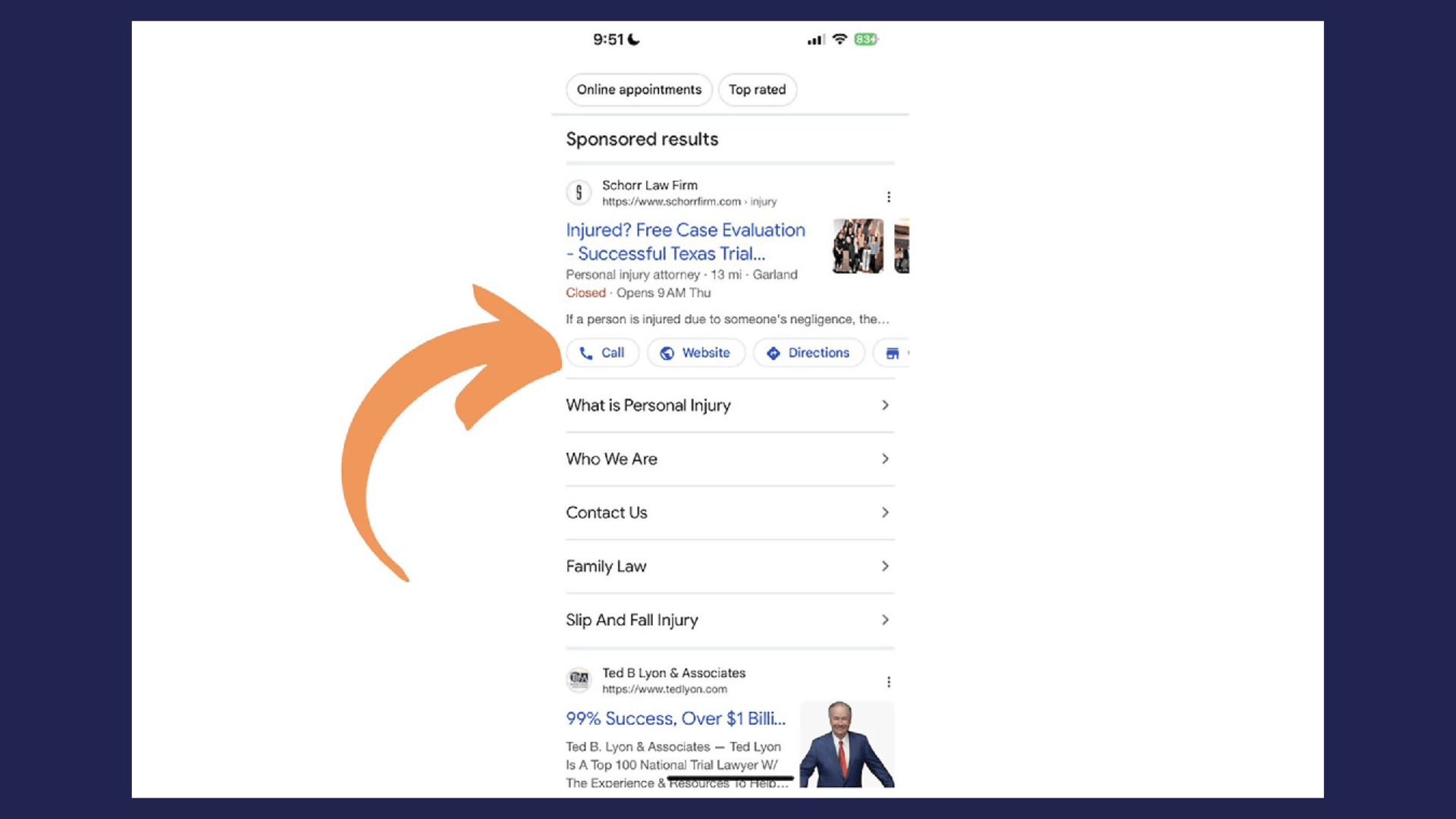
Recent examples show Local ads featuring up to nine distinct links within a single unit — including call, website, directions, and multiple sitelinks — while the headline and description are partially cut off or visually minimized.
Instead of encouraging users to read and evaluate, these ads encourage them to act immediately.
This isn’t a cosmetic update. It’s a behavioral one.
What’s Changing
- Clickable assets are more prominent than primary text
- Headlines and descriptions are visually deprioritized
- Action buttons dominate the layout
- Engagement is driven by interaction, not persuasion
In short: Local ads are shifting from “convince and convert” to “offer options and let users choose.”
Why This Matters
When more clickable options are placed front and center, the structure of your asset set becomes the strategy.
Each sitelink, call button, and extension is no longer a supplement — it’s a core performance driver.
If those links are generic, misaligned, or poorly optimized, performance will suffer — even if your headline is strong.
This format favors advertisers who:
- Anticipate user intent
- Provide immediate pathways to action
- Align each asset with a specific conversion goal
Our Take
As Adriaan Dekker points out, with more clickable options leading the ad experience, local advertisers need to rethink how they structure and optimize asset sets to drive action.
We agree.
The shift signals that Google believes local searchers don’t want to read — they want solutions. The faster you present relevant next steps, the more likely you are to win the click.
This means asset strategy is no longer secondary to copywriting. In many cases, it may matter more.
The question isn’t just “Is the ad compelling?”
It’s “Does every link serve a clear purpose?”
What ADSQUIRE Is Doing
We’re restructuring Local campaigns around action-first architecture.
Asset Strategy Overhaul
- Auditing every sitelink, callout, and extension for relevance and performance
- Removing redundant or low-value links
- Creating intentional pathways tied to specific services or high-intent queries
Mobile-First Optimization
- Ensuring every asset leads to a fast, conversion-ready page
- Prioritizing click-to-call functionality during intake hours
- Aligning directions and location links with proximity-based searches
Intent-Based Structuring
- Matching asset sets to user search behavior
- Building distinct link frameworks for urgent vs. informational queries
- Tracking asset-level engagement to refine performance
Bottom Line
Local ads are evolving into multi-link engagement hubs.
With clickable options now driving visibility and interaction, advertisers must rethink how asset sets are structured, prioritized, and optimized.
The firms that treat assets as strategic conversion tools — not add-ons — will outperform competitors still relying on headline-driven persuasion.
At ADSQUIRE, we’re already optimizing campaigns for this click-first future.