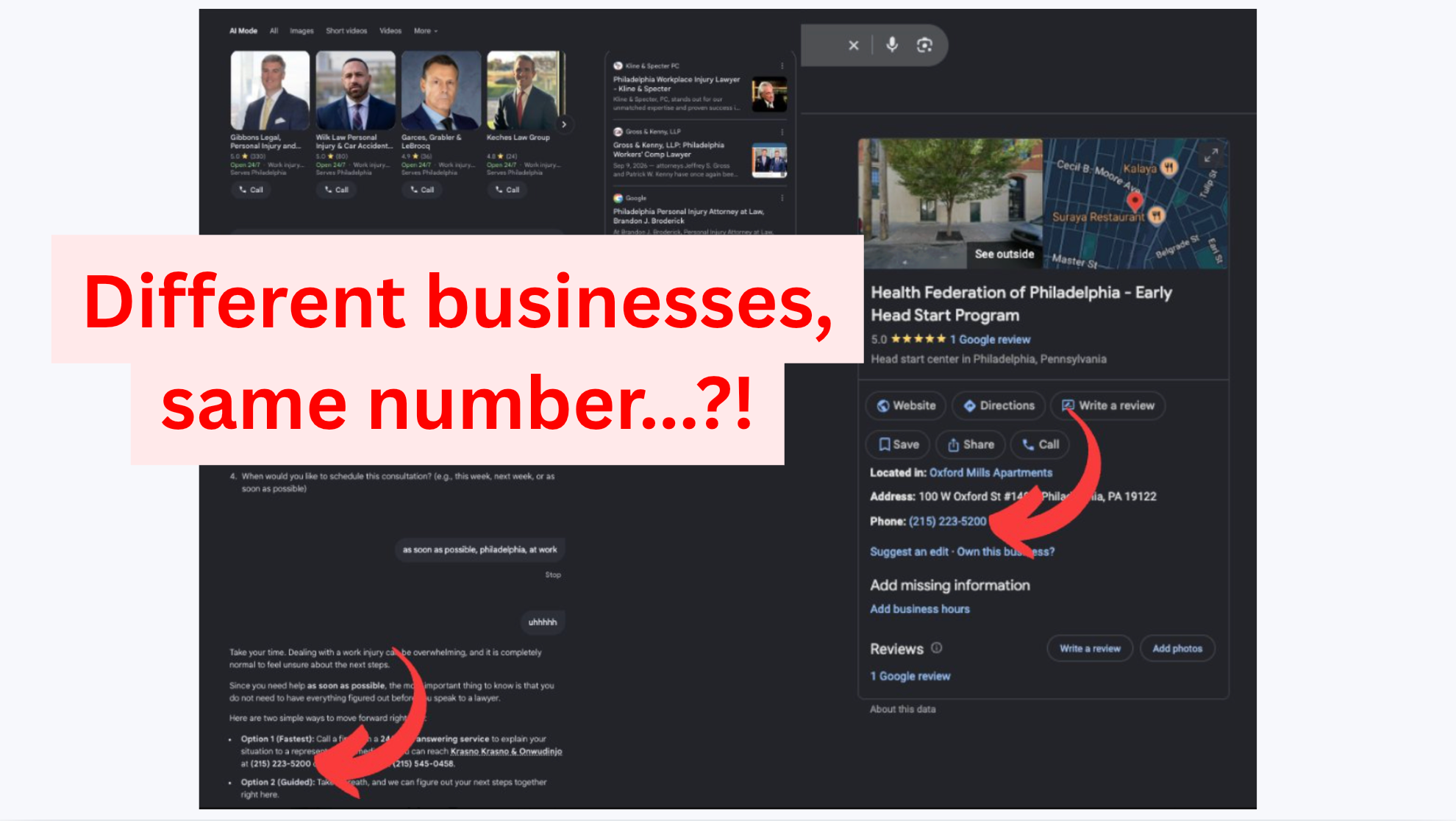
On September 15, using Google AI Mode to ask about a work injury in Philadelphia, an AI assistant suggested several law firms and then handed back phone numbers for them. One of those numbers matched the listing for an unrelated early head start program. We posted about it that night: see the post
AI Mode’s check-for-me feature asked what kind of work the person did, whether a claim had been filed, which neighborhood was convenient, and when they wanted to schedule. That is an intake script. Then it answered with a shortlist and instructions to call – no firm controls and no dashboard reports.
This is not a ranking problem. It is a serious destination problem. The prospect dials, someone else answers, and the firm never learns the call existed.
What This Means for Law Firms
For a personal injury or workers’ comp practice, this is the top of the funnel now. Someone hurt at work asks an assistant who to call, and the assistant answers as if it has verified contact details. It has not. Google’s AI calling feature, which now dials businesses on a user’s behalf in most states, makes that worse: a wrong number does not just send a click to the wrong place, it can send a call.
None of this shows up in reporting. There is no impression, no click, and no missed call, because the lead never reached your line. A firm can lose a case a week to this and see nothing but a soft month.
Firms also control less of this than they think. Google Business Profile accuracy, consistent name, address, and phone across the web, structured data, and clean citations all help the model retrieve the right details. None of them guarantee which number gets attached to your name, and none of them give you a way to audit the answer at scale.
Our Take
The anger is proportionate. Google is positioning itself as the intake layer for legal services, in the most vulnerable moment a client will ever have, without an accuracy standard or a way for a firm to correct a wrong answer. “Ask businesses for me” is a fine feature until the model invents a number and a stranger picks up.
The practical response is not to wait for a fix. Test AI Mode the way you test a landing page: monthly, per market, per practice area, with the same questions a client would ask. Log what it says about your firm and your competitors, use the suggest-an-edit path where it exists, and make your authoritative data as easy to retrieve as possible.
The bigger lesson is about dependency. A channel that can fabricate your phone number is a channel you cannot treat as infrastructure. Firms that put every dollar into one discovery surface are one model update away from a bad quarter.
What ADSQUIRE Is Doing
We are treating AI answers as a channel to monitor. That means:
- Running AI Mode checks per market and practice area, using the questions a client would actually ask
- Auditing Business Profile data and name, address, and phone consistency across citations
- Reviewing structured data so the correct number and service area are the easiest version to retrieve
- Logging wrong answers and wrong numbers, with screenshots, for client records and for feedback to Google
- Keeping source capture in intake, so a lead that never arrived can be spotted in the pattern
- Telling clients plainly which parts of this they can control and which they cannot
For law firms, the goal is not to make Google accurate. It is to know what Google is telling your market, and to be findable and correct everywhere you can be.
Conclusion
Google AI Mode gave out wrong phone numbers for law firms and put one of them next to an unrelated business. The feature is doing intake work now, which means its errors land in the one place legal marketing can least afford them.
Firms cannot fix the model. They can make their own data authoritative, monitor what the model says, and stop assuming a silent month means a slow market. Some of those missing calls went somewhere.
For law firms, the phone number is still the business. When a search engine starts assigning them, monitoring is no longer optional.