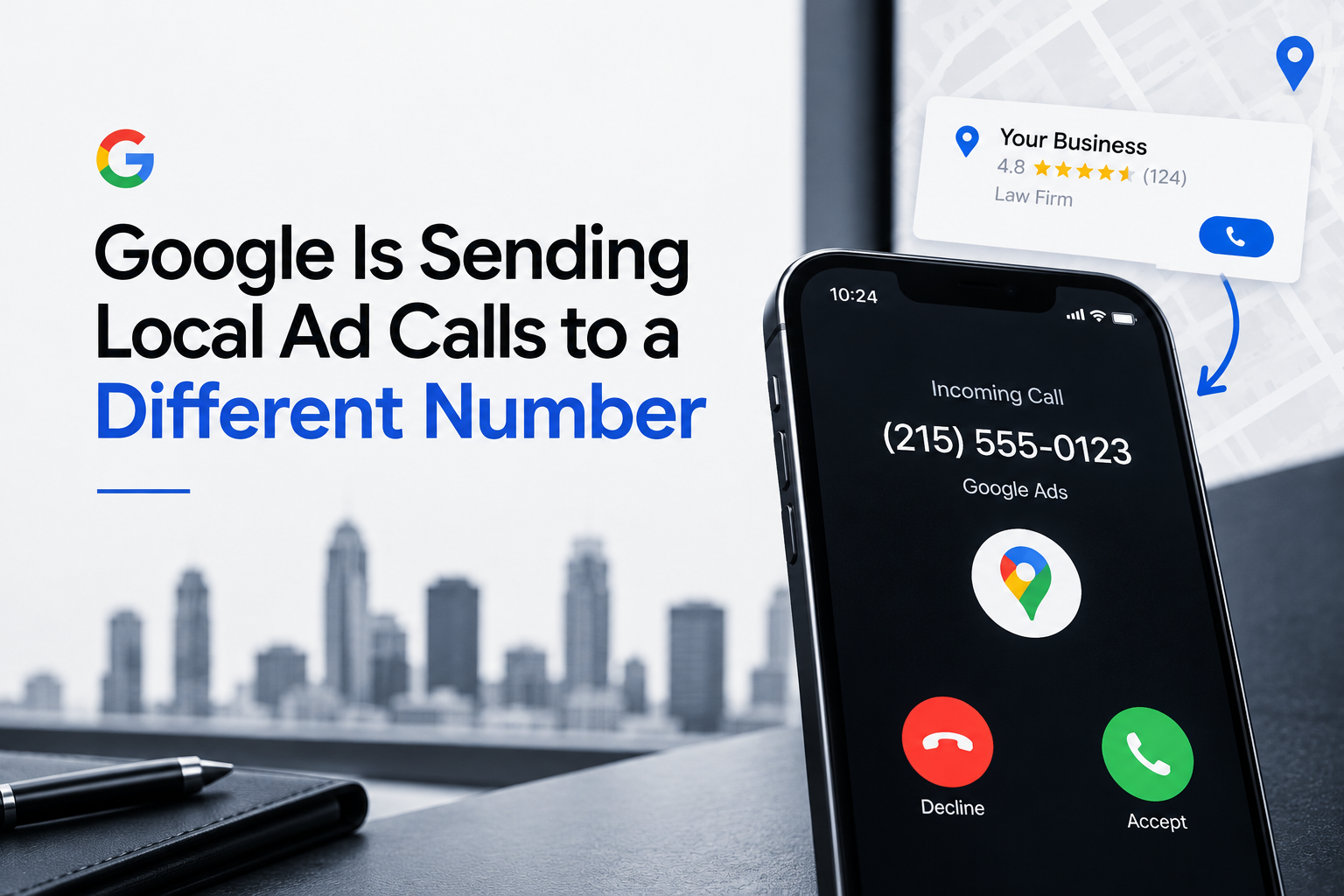
On September 1, agencies began reporting that Google’s local ad formats were showing the phone number attached to the Google Business Profile instead of the number configured in the Google Ads call asset, even with the Ads number set in the profile’s advanced settings. We posted about it that day: see the post
Google confirmed the behavior on September 9: “If you are utilizing both location and call assets, ads featuring specific business locations may direct calls to the phone numbers associated with those locations rather than those set within your call assets.” It has not said it will change back. Since then the behavior has been inconsistent. Some accounts report the Ads number working again. Others still see the profile number on every local format.
For a law firm, that means the number that rings is not always the number the dashboard counts. Call tracking, call recording, and source tagging all assume the line you configured is the line that rang. Increasingly, this is not the case.
What This Means for Law Firms
Local Services Ads are how a lot of consumer legal work gets found. They are also billed per lead, and Google’s own lead count usually survives this change. The damage is downstream. If a call lands on the profile number, your call tracking platform never sees it, the recording never happens, and your CRM tags the lead as organic or unknown. The campaign still gets credit inside Google. Nothing else does.
That leaves firms with an impossible choice. Keep location assets and lose the ability to prove which calls came from ads. Drop location assets and lose the address, proximity signal, and map presence that made the format worth running. Neither option is free, and most multi-office firms need both.
There is an operational risk too. The profile number is the public number, and in a firm with several offices it may route to the wrong one. A caller with a matter that belongs in the downtown office reaches whoever answers first. Intake scripts and “how did you hear about us” become the only source data left, and they were never reliable to begin with.
Our Take
The part that should worry agencies is not the bug. It is the framing. Google described a change that broke tracking as expected behavior between two asset types. That means the configuration screen can be correct while the ad is wrong, and no alert will tell you. You have to check the live ad, per location, or you will not know.
We are not waiting for a revert. The practical fix is to stop treating the call platform as ground truth for Local Services Ads. Reconcile three counts every month: leads in the Local Services app, calls in the tracking platform, and calls in the Business Profile insights. Where they disagree, the gap is the story, and budget decisions should wait until it is explained.
This also fits a pattern. Google has spent the year wiring the Business Profile and the ads account closer together, including folding Local Services into Performance Max. Every one of those changes makes a profile-level setting capable of changing what a customer experiences in a paid ad. Firms that manage both surfaces as separate products will keep getting surprised.
What ADSQUIRE Is Doing
We are auditing call routing account by account. That means:
- Running the three-number check per location: the live ad, the call asset, and the profile’s primary number
- Reconciling Local Services leads against the call platform and profile insights every month
- Pointing tracking at the profile number where that is now the number of record for a location
- Confirming which office each location routes to, and whether its intake team handles those matters
- Keeping source capture in the intake script as a backup, not a primary source
- Documenting the gap for clients so nobody cuts a budget based on a dashboard that is counting the wrong line
For law firms, the goal is not to argue with Google about which number should ring but to know which one did.
Conclusion
Google’s local ad formats are routing calls to the profile number instead of the Ads call asset, and Google has confirmed the behavior rather than fixed it. For law firms, the consequence is a reporting gap that looks like a performance drop and an intake gap that looks like nothing at all.
Leads are probably not disappearing. The ability to attribute them is. Firms that reconcile the numbers will keep making good decisions. Firms that trust a single dashboard will cut spend on the channel producing cases, or credit a channel that is not.
For law firms, the phone number is the attribution. When Google changes which one rings, the measurement has to change with it.