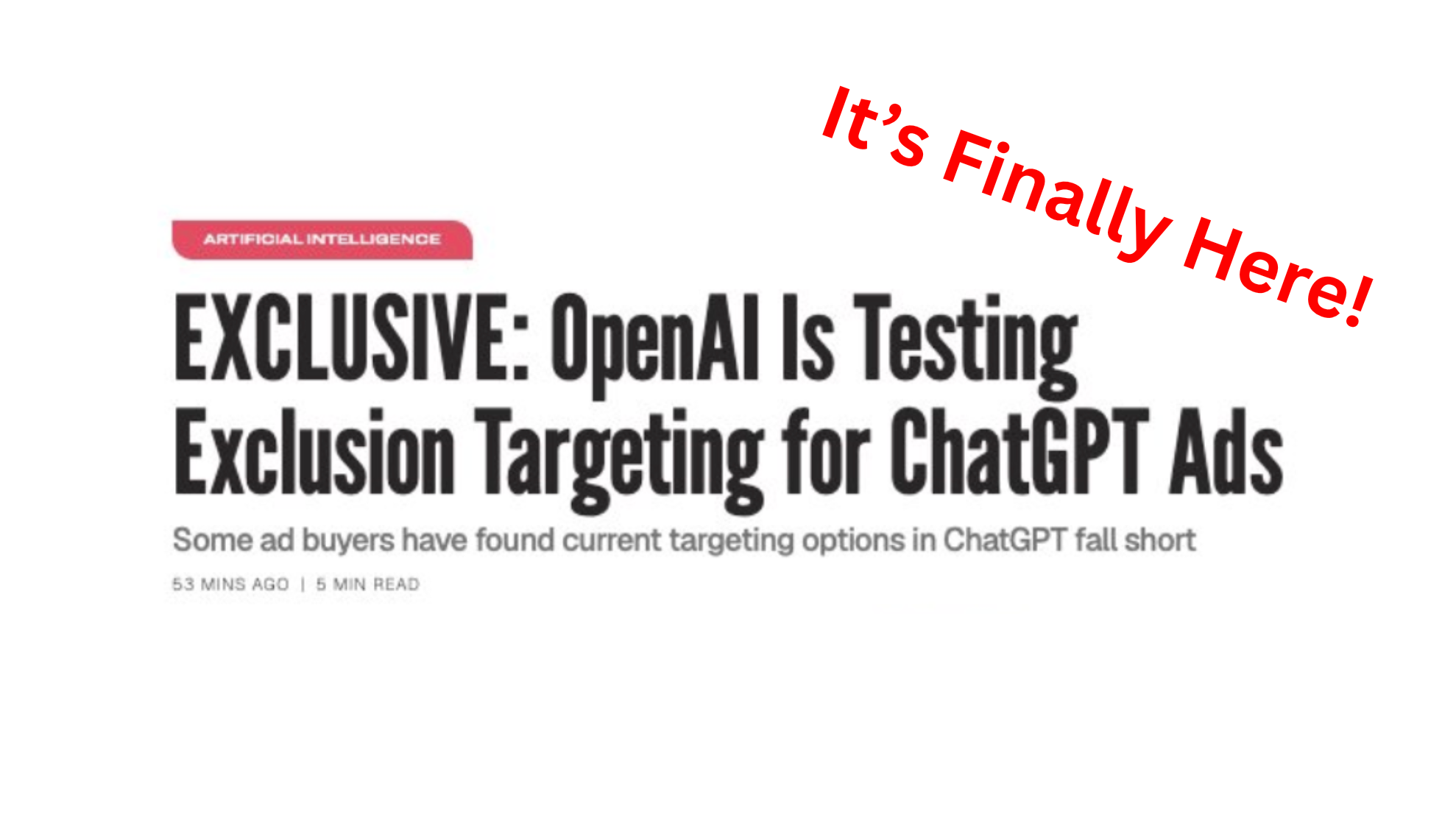
OpenAI has confirmed it is testing exclusion targeting for ChatGPT ads, a control that lets advertisers flag conversations they do not want their ads to appear beside. We posted about it on X the day the news broke: see the post
The feature was live before anyone announced it. A Negative phrases field appeared inside a UK advertiser’s Ads Manager in August, ahead of any public notice. It sits under Settings and accepts up to 100 phrases at 100 characters each. When a user’s message contains one of those phrases, the ad does not show.
That makes it a hard exclusion. Context hints, the control advertisers have had until now, only describe what a business offers and nudge relevance. OpenAI says explicitly that hints cannot enforce exclusions. Negative phrases are the other half of that pair.
On October 5, OpenAI moved the feature from rumor to policy. Its announcement says Negative Phrases are “now available to qualifying advertisers” for “narrow placement requirements specific to a brand’s own policies.” That is the whole of it. OpenAI has published no eligibility rules, matching behavior, scope, or API support, and no report shows what a phrase actually blocked. That gap matters, because relevance is uneven: a SE Ranking analysis of 50,006 commercial prompts found 14.35% of ChatGPT ads had no topical connection to the prompt, and the mismatch ran above 50 percent in Relationships and News & Politics.
What This Means for Law Firms
Legal services opened to US advertisers on August 31 under manual approval and state licensure rules. Until now, a firm could describe its practice and hope the model understood. Negative phrases let a firm say no.
For most firms, the list writes itself:
Practice-area mismatch. A personal injury firm does not want to pay for criminal defense, family law, or bankruptcy queries.
Jurisdiction mismatch. Geographic targeting controls where an ad appears, not what the conversation asks. A Florida-only firm has no use for a question about California procedure.
Sensitive adjacency. OpenAI’s guardrails already keep ads out of health, mental health, and political contexts. A firm may still want margin beyond the platform floor.
The ethics question does not go away. OpenAI’s approval does not replace state bar rules or the ABA Model Rules of Professional Conduct. Model Rule 7.1 still prohibits false or misleading communications, and that reaches every headline, description, and prompt-style line inside an ad. An exclusion list is not a compliance framework.
There is also a trap worth naming early. ChatGPT Ads has no search terms report, so nothing tells you what a phrase blocked. Broad single words will quietly remove reach you wanted.
Our Take
The reaction on our own X post was blunt: thank God, and hurry up. We have been asking for placement control since the legal category opened, because the system can find a legal question but we cannot tell it which legal questions are ours. This is the negative-keyword layer the channel needed, and it was always going to arrive. The only question was when.
We are not treating it as a launched feature. It is a test, with a small advertiser group, a gate OpenAI calls “qualifying,” and one sentence of documentation. What would make it a real control is a report: a way to audit what a phrase blocked, at what volume, and against which conversations. Without that, a negative list is a guess you keep on file.
The direction is right, though. Negative phrases, brand suitability pilots with DoubleVerify and IAS, and a platform that now spans 26 more countries and more than 100,000 advertisers. And cheap clicks are still wasted clicks. Legal clicks inside ChatGPT average around $3.40, a fraction of a personal injury click on Google. A firm that pays for the wrong conversations at scale has simply found a cheaper way to waste money.
What ADSQUIRE Is Doing
We are preparing client accounts for exclusion targeting now. That means:
- Auditing which accounts have the Negative phrases field and what qualifies
- Building practice-area exclusion lists per client, reviewed by the firm rather than copied from a Google account
- Aligning exclusions with licensure so ads stay out of conversations tied to states where the firm is not admitted
- Keeping a change log with the date, rationale, and owner for every phrase, since delivery shifts cannot be attributed otherwise
- Measuring before and after by practice area: impressions, click-through rate, form fills, and lead quality, not volume alone
- Reviewing every list against Model Rule 7.1 and the firm’s state bar rules with its compliance contact
For law firms, the objective is not the longest blocklist. It is to be precise.
Conclusion
OpenAI is testing exclusion targeting for ChatGPT ads, and Negative Phrases are already showing up in some accounts. The October announcement opens the control to qualifying advertisers while leaving the mechanics undocumented. For law firms, that is a meaningful step and an incomplete one.
The benefit is real. A firm can now keep spend out of conversations it cannot serve, cannot convert, or should not be adjacent to. The risk is false confidence. A control without reporting is easy to overuse and hard to audit, and no exclusion list substitutes for compliant ad copy.
For law firms, control over message and compliance remains the standard. As ChatGPT Ads scales past 100,000 advertisers, the firms that do well will not be the ones with the most aggressive blocklist. They will be the ones that can explain, in writing, why every phrase on it is there.