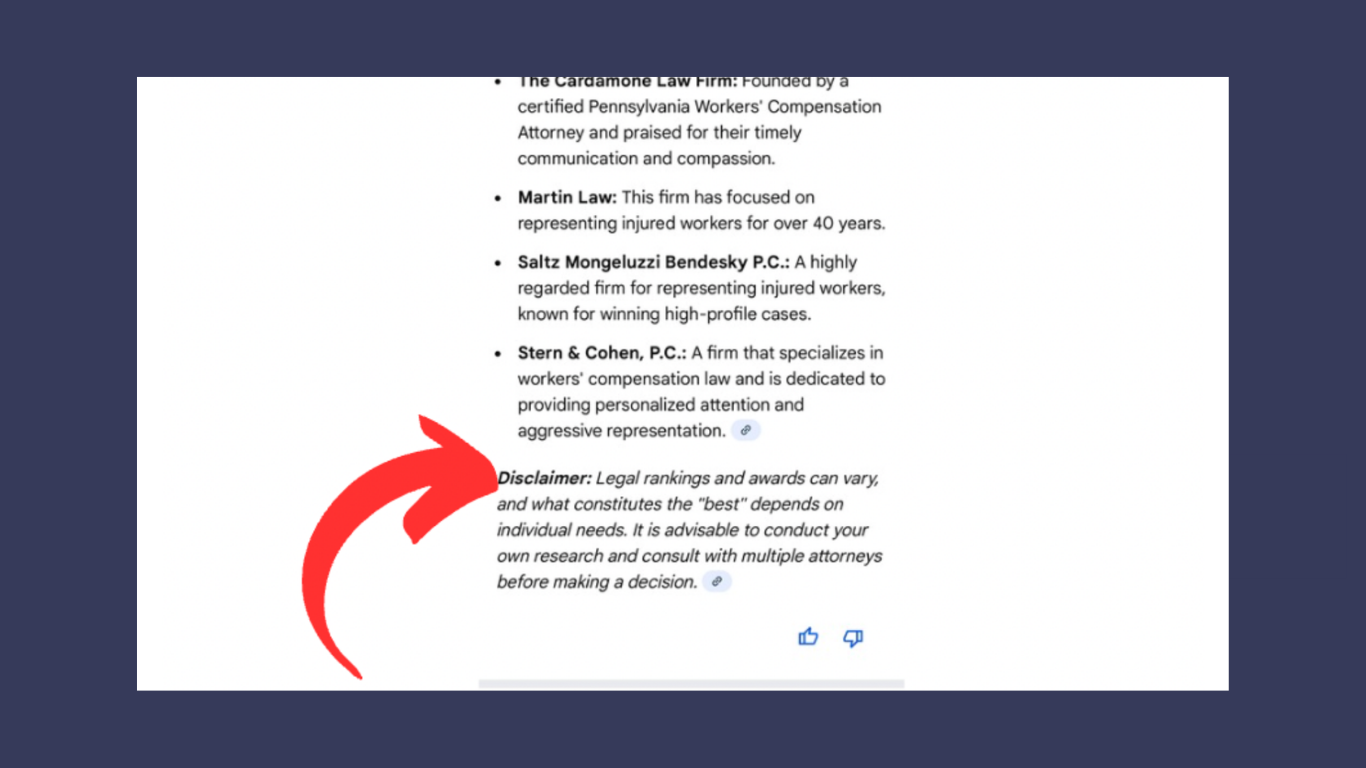
Google has begun displaying a new disclaimer within AI Overviews for certain legal-related searches. The language appears when users search for queries tied to rankings, awards, or “best” designations and reads:
“Legal rankings and awards can vary, and what constitutes the ‘best’ depends on individual needs. It is advisable to conduct your own research and consult with multiple attorneys before making a decision.”
While subtle, this disclaimer is a meaningful signal about how Google is thinking about legal search results—especially as AI-generated summaries become more prominent across the SERP.
What’s New
The disclaimer is appearing directly inside AI Overviews for legal searches that imply quality judgments, such as:
- “Best personal injury lawyer near me”
- “Top criminal defense attorney”
- “Best lawyer in [city]”
Rather than presenting a definitive list or hierarchy, Google is explicitly distancing itself from endorsing any single firm or ranking. This aligns with broader efforts to reduce perceived liability and reinforce that legal decisions are subjective and context-dependent.
Importantly, this disclaimer does not remove firms from AI Overviews—but it does change how authoritative those summaries appear.
Our Take
This has real implications for SEO and GEO (Generative Engine Optimization) strategies in legal marketing.
For years, law firm SEO has leaned heavily on “best,” “top,” and award-driven language. Google’s new disclaimer suggests increasing discomfort with positioning AI-generated results as objective truth in a highly regulated, high-stakes category like legal services.
What this signals:
- Google is being more cautious about evaluative claims in legal search
- AI Overviews may downplay or contextualize ranking-style content
- “Best near me” queries may become less reliable as a primary growth strategy
This doesn’t mean those searches stop mattering—but it does mean firms relying solely on superlatives and third-party badges may see diminishing returns in AI-driven results.
Instead, we expect stronger performance from content that emphasizes:
- Practice-area specificity
- Situational relevance (case type, severity, jurisdiction)
- Experience, process, and outcomes—without overreaching claims
In other words, Google is nudging legal search away from absolute rankings and toward nuanced, user-specific decision-making.
What ADSQUIRE Is Doing
We’re already adjusting how we approach SEO and AI visibility for law firms in response to this shift.
Our strategy includes:
- Diversifying content away from pure “best lawyer” framing
- Strengthening practice-area pages with intent-based language tied to real legal scenarios
- Optimizing for AI Overviews by emphasizing clarity, credibility, and context—not just awards
- Monitoring how disclaimers impact click-through behavior from AI-generated results
We’re also watching how these disclaimers affect paid and organic interactions together, especially as AI Overviews increasingly sit above traditional listings.
For law firms, the goal isn’t to abandon competitive positioning—it’s to support it with substance that AI systems can confidently summarize without hedging.
The Bottom Line
Google’s new AI Overview disclaimer for legal searches is a small change with big strategic implications.
As AI continues to shape how users discover and evaluate lawyers, firms that rely exclusively on “best” claims risk being softened or qualified by the platform itself. The firms that win will be those that meet users where they are—addressing specific needs, concerns, and legal situations rather than chasing universal rankings.
In an AI-driven SERP, credibility and relevance matter more than superlatives.