Google continues to evolve how advertisers can reach users on Display and Demand Gen campaigns, and one of the more meaningful recent developments is the expansion of new audience options—particularly for advertisers in sensitive categories like legal services.
While audience targeting has historically been restrictive for lawyers due to policy limitations around personalization, these updates suggest a shift toward more usable, compliant targeting methods that still respect Google’s advertising guardrails.
What’s New
Google is rolling out expanded audience availability across Display and Demand Gen, including broader access to Custom Segments tied to intent and in-market behaviors.
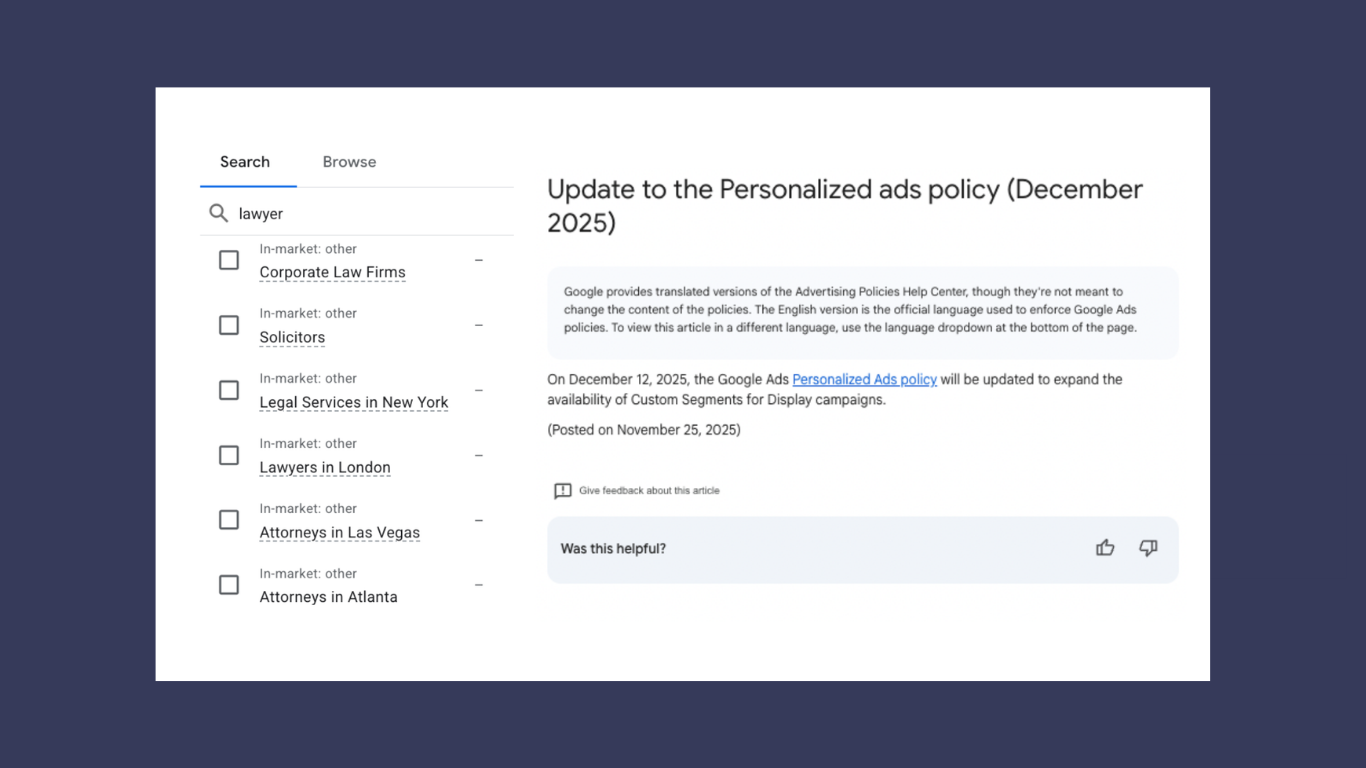
This change aligns with Google’s upcoming update to the Personalized Ads policy, which takes effect on December 12, 2025, and explicitly expands the availability of Custom Segments for Display campaigns.
In practice, advertisers are now seeing more granular, location- and profession-specific in-market audiences appear—without having to rely on prohibited or overly invasive targeting methods.
Examples currently appearing include:
- In-market (Other): Legal Services in New York
- In-market (Other): Solicitors
- In-market (Other): Lawyers in London
- In-market (Other): Corporate Law Firms
- In-market (Other): Attorneys in Las Vegas
- In-market (Other): Attorneys in Atlanta
These audiences sit within Google’s pre-built, pre-approved in-market category, making them different from custom-built or personally identifiable targeting methods that lawyers in sensitive ad categories often cannot use.
Our Take
This is a meaningful development for law firms—especially those in personal injury, criminal defense, and other sensitive practice areas that are typically blocked from using traditional Custom Audiences.
Historically, lawyers have had to choose between:
- Broad, generic targeting that lacks efficiency, or
- Riskier custom strategies that push against policy boundaries or don’t serve
These new in-market-style audiences offer a middle ground: more granular than broad affinity targeting, but still compliant with Google’s legal and personalized advertising rules.
We also believe this rollout is directly connected to Google’s policy updates, not a coincidence. As Google tightens enforcement around personalized ads, it’s simultaneously introducing “approved” alternatives that allow advertisers to retain performance without violating policy.
For lawyers, that means:
- Better geographic and service-level relevance
- Less reliance on workaround targeting strategies
- More predictability around compliance
That said, these audiences are still intent-based—not guarantees of legal need. They work best when paired with strong creative, compliant messaging, and landing pages designed to convert high-intent users.
What ADSQUIRE Is Doing
We’re actively testing and integrating these new audiences across Display and Demand Gen campaigns for law firm clients where appropriate.
Specifically, ADSQUIRE is:
- Identifying which new in-market and “Other” legal audiences are eligible per market and practice area
- Layering these audiences into Demand Gen and Display campaigns to improve relevance without triggering policy issues
- Monitoring performance closely to compare lead quality versus broader targeting approaches
- Aligning audience strategy with Google’s December 2025 Personalized Ads policy update to future-proof campaigns
Just as importantly, we’re not treating these audiences as a silver bullet. They’re being used as part of a broader strategy that includes search, LSAs, compliant creative testing, and strong intake alignment.
The Bottom Line
Google’s expansion of audience options for Display and Demand Gen signals a broader shift: stricter personalization rules paired with more refined, policy-safe alternatives.
For lawyers—especially those who have long felt boxed out of advanced audience targeting—this is a step in the right direction. Used correctly, these audiences can provide more efficient reach without compromising compliance or reach.
As always, the firms that win won’t be the ones chasing every new option—but the ones who test thoughtfully, stay within policy, and adapt as the platform evolves.