As we closed out 2025, Google’s platforms continued to evolve in ways that directly impacted law firms. From AI reshaping search results and local listings to new audience and ad placement options, the way potential clients find and engage with your firm is changing.
We’ve compiled the most important updates from the past few weeks into one cohesive breakdown, explaining what changed, why it matters, and how ADSQUIRE is responding in the new year.
Google Ads Adds Google Maps as a Broken Out Channel for Demand Gen
Google has added Google Maps as a selectable channel within Demand Gen campaigns for some advertisers. While still rolling out, this is the most direct step yet toward integrating Demand Gen with Maps visibility.
Our Take: Lawyers have long asked for a Maps-specific advertising option beyond organic GBP results. This update appears to be rolling out soon and could fulfill this exact need, although we are not sure exactly what it will look like yet. Maps is inherently high-intent: users are local, time-sensitive, and often deciding between immediate options.
For practice areas like PI, DUI, and criminal defense, Maps placements could influence decisions earlier in the funnel—before a call or message is placed.
That said, Demand Gen remains creative- and audience-driven. Success here will depend heavily on messaging, format, and how Maps placements interact with LSAs and search.
What ADSQUIRE Is Doing: We’re prepped to test Maps placements once they become fully available, which, at that point, we will:
- Run Maps-heavy and mixed-channel Demand Gen tests
- Compare results against Discover, YouTube, and Gmail
- Monitor downstream effects on branded search, calls, and GBP engagement
- Adjust creative to match Maps-specific user intent
Google Adds Search Partners Segmentation to Performance Max Reporting
Google has officially added Search Partners as a visible segment within Performance Max channel reporting. Advertisers can now see how much of their PMax performance comes from Google Search versus the Search Partners Network (SPN).
This change comes after Google spent months quietly cleaning up SPN—removing lower-quality sites, tightening eligibility, and addressing the placements that historically made Search Partners feel risky and opaque. Only after that cleanup did Google surface the data.
Our Take: This doesn’t suddenly make Performance Max a precision tool, but it does make it more appealing. Search Partners has long been the least understood part of Google Ads, especially for lawyers who need to know exactly where their leads are coming from. By improving the network first and exposing reporting second, Google is acknowledging that transparency matters—particularly in regulated, high-cost verticals.
For law firms, this means better context during performance reviews and more informed conversations about where PMax is actually working versus where it’s simply spending.
What ADSQUIRE Is Doing: We’re incorporating this new segmentation directly into our PMax reviews and evaluating lead quality differences between channels.
New Audiences for Display & Demand Gen: Great for Lawyers in Sensitive Ad Categories
Google is expanding audience availability across Display and Demand Gen campaigns, particularly through new in-market “Other” audiences tied to legal services and geographic intent. This rollout aligns closely with Google’s upcoming Personalized Ads policy update on December 12, 2025, which expands Custom Segment availability while tightening enforcement elsewhere.
These new pre-built audiences include:
- In-market (Other): Legal Services in New York
- In-market (Other): Attorneys in Las Vegas
- In-market (Other): Corporate Law Firms
- In-market (Other): Lawyers in London
Our Take: This is a meaningful development for lawyers who have historically been unable to target more specific audiences due to policy restrictions. These audiences offer a middle ground: more specific than broad affinity targeting, but still compliant with Google’s rules for sensitive categories like personal injury law.
We don’t see this as accidental. As Google restricts certain forms of personalization, it’s simultaneously introducing policy-safe alternatives to preserve performance. For lawyers, that means better relevance without risky workarounds—but these are still intent signals, not guarantees.
What ADSQUIRE Is Doing: We’re actively testing these audiences where appropriate by:
- Mapping eligible audiences by market and practice area
- Layering them into Demand Gen and Display campaigns cautiously
- Comparing lead quality against broader targeting approaches
They’re a tool—not a shortcut—and we’re treating them accordingly.
New Disclaimer Appearing in AI Overviews for Legal Searches
Google has begun showing a disclaimer in AI Overviews for legal searches involving rankings or “best” claims, stating that legal rankings vary and users should conduct their own research:
“Legal rankings and awards can vary, and what constitutes the ‘best’ depends on individual needs. It is advisable to conduct your own research and consult with multiple attorneys before making a decision.”
Our Take: This is a small UI change with large strategic implications. Google is signaling discomfort with presenting AI-generated legal rankings as objective truth. For firms heavily reliant on “best lawyer near me” strategies, this suggests potentially diminishing returns—especially in AI-driven results.
We expect stronger performance from content that emphasizes specificity, situational relevance, and clarity over superlatives.
What ADSQUIRE Is Doing: We’re adjusting GEO strategies by:
- Diversifying away from pure “best lawyer near me” targeting
- Strengthening practice-area and scenario-based content
- Optimizing for AI summaries built on credibility and context
- Monitoring how disclaimers affect click behavior
The goal isn’t to abandon competitive positioning—it’s to support it with substance.
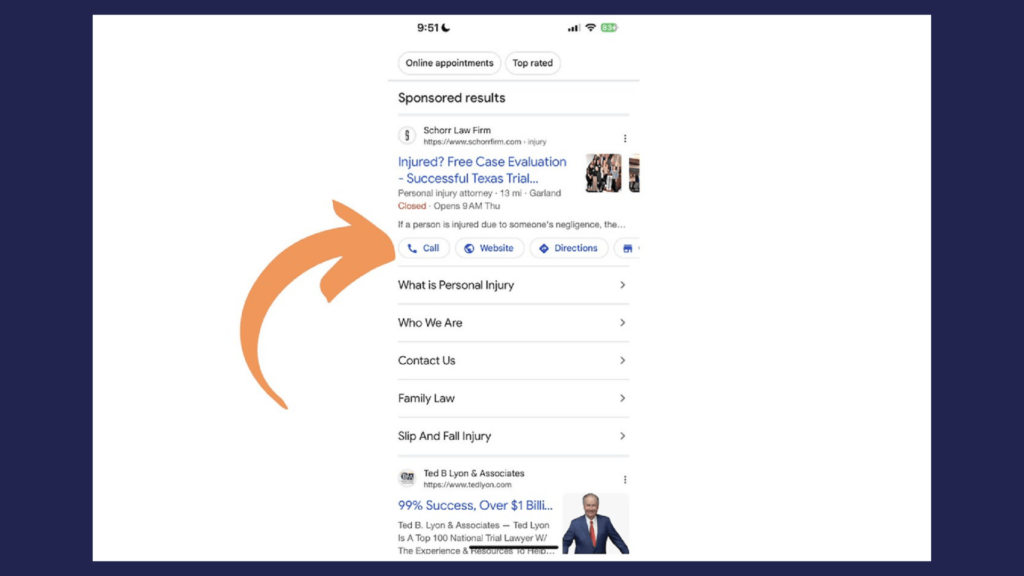
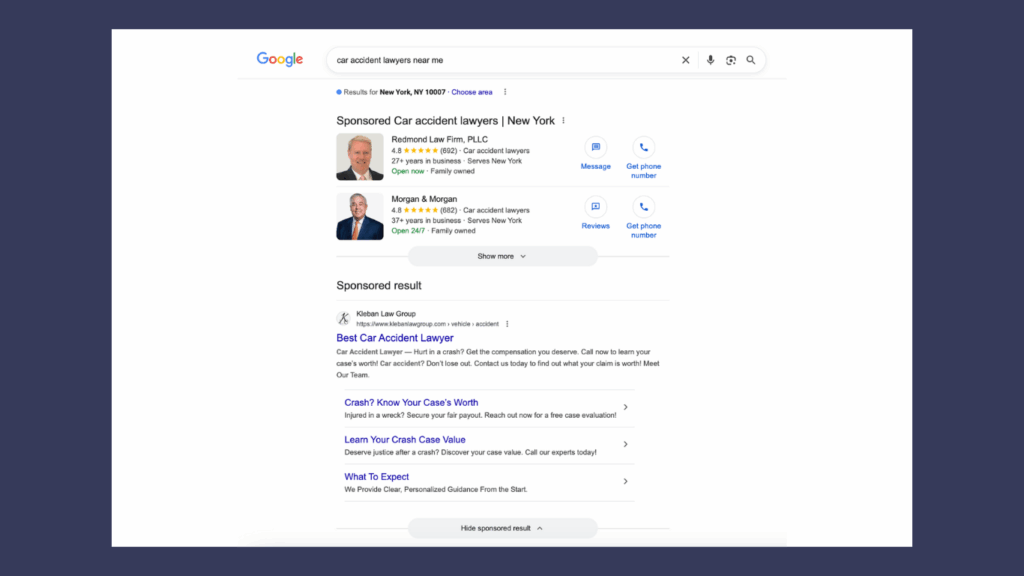
Are LSA Leads Dropping?
We’re seeing consistent signs of reduced LSA lead volume following Google’s shift from expanded LSA lists to an 8-business visibility cap.
Our Take: This change shrinks the playing field. Fewer visible firms means fewer total leads—not just redistribution. LSAs are becoming less forgiving, with more weight on performance history, reviews, responsiveness, and proximity.
What ADSQUIRE Is Doing: We’re focusing on the signals that keep firms inside the visible group:
- Weekly budgeting strategies
- 5 star reviews
- Fast response times
- In some cases, turning the profile off
If leads are down, it may not be a firm issue—it may be a visibility one.
Google Tests a New “Learn More” Button on Search Ads
A new “Learn more” CTA is appearing directly in paid search ads, offering a softer engagement option.
Our Take: For legal searches—where hesitation is common—this could improve CTR and blur the line between paid and organic results.
What ADSQUIRE Is Doing: We’re monitoring CTR, lead quality, and landing-page alignment to ensure softer clicks still convert meaningfully.
Hidden Location Settings Added to Google Ads
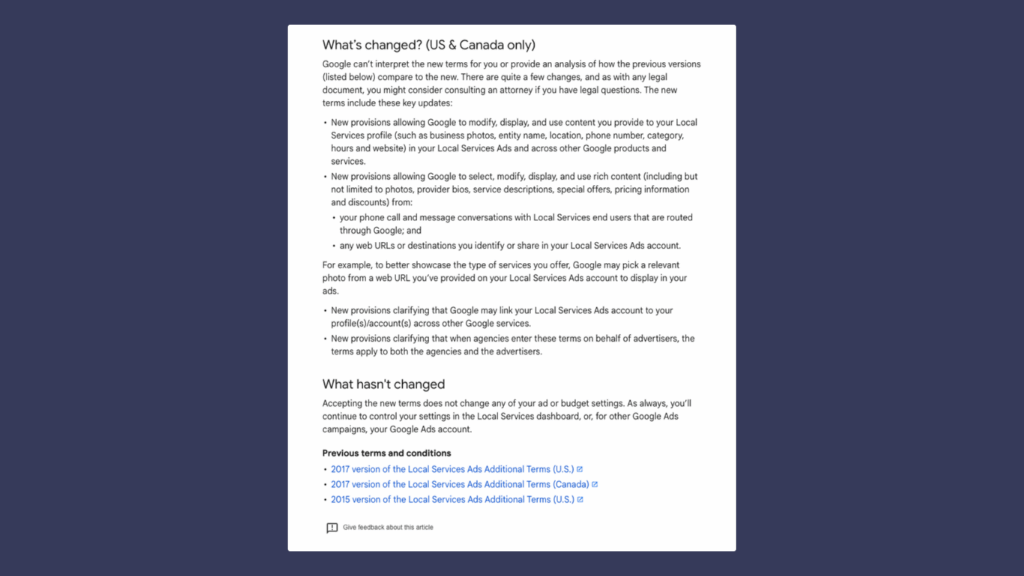
Google quietly enabled new location settings, including permission to use Google-owned photos and media by default.
Our Take: This continues a pattern: automation added quietly, enabled by default, and easy to miss.
What ADSQUIRE Is Doing: We’re auditing Location Manager settings across accounts and disabling anything clients didn’t explicitly approve.
Google Ads Advisor: Efficiency or Over-Automation?
Ads Advisor bundles existing automation into a guided workflow for campaign setup and optimization.
Our Take: Used blindly, it can quietly reshape campaigns toward Google’s goals rather than yours—especially risky for lawyers where lead quality matters more than volume.
What ADSQUIRE Is Doing: Ignoring 98% of Ads Advisor recommendations and sticking with our own optimization strategies.
AI-Generated Google Business Profile Descriptions on Mobile
Google is testing AI-generated GBP summaries pulled from websites, social profiles, and directories, sometimes paired with a “Dive deeper in AI Mode” button immediately after.
Our Take: This shifts narrative control. Your GBP is no longer just what you write—it’s what Google infers. Consistency across the web now directly shapes first impressions.
What ADSQUIRE Is Doing: We’re auditing and aligning all external signals feeding these summaries and monitoring how they affect calls, clicks, and interactions.
Gemini Is Being Pushed Deeper Into Chrome
Gemini is now embedded directly into Chrome, reinforcing Google’s broader AI adoption push.
Our Take: This is more about distribution than breakthrough utility—for now. But it shows how aggressively Google is normalizing AI-assisted experiences.
What ADSQUIRE Is Doing: We’re tracking how these tools intersect with search behavior and advertiser workflows without over-adopting prematurely.
Google Tests a New Mobile Path Into AI Mode
Google is testing new ways to push users from traditional search results directly into AI Mode, including transitional interfaces and follow-up prompts that bypass classic SERPs entirely.
Our Take: Google is clearly pushing AI adoption more aggressively. This isn’t just UX polish—it’s behavior shaping. For lawyers, this means visibility inside AI experiences is becoming as important as rankings themselves.
What ADSQUIRE Is Doing: We’re tracking:
- Which queries trigger AI overviews
- How AI visibility affects downstream traffic and calls
Early awareness makes adaptation far easier than late reaction.
Closing Thoughts
None of these updates alone rewrite legal marketing. Together, they paint a clear picture: Google is consolidating control, pushing AI deeper into discovery, and reducing friction for users—sometimes at the cost of advertiser transparency.
For lawyers, success now depends less on chasing every new feature and more on understanding how these shifts interact. Strategy, compliance, and early testing matter more than ever.
At ADSQUIRE, our role is simple: track changes early, translate impact clearly, and help law firms adapt before shifts become problems—not after.
We’ll continue monitoring, testing, and reporting as this landscape evolves.