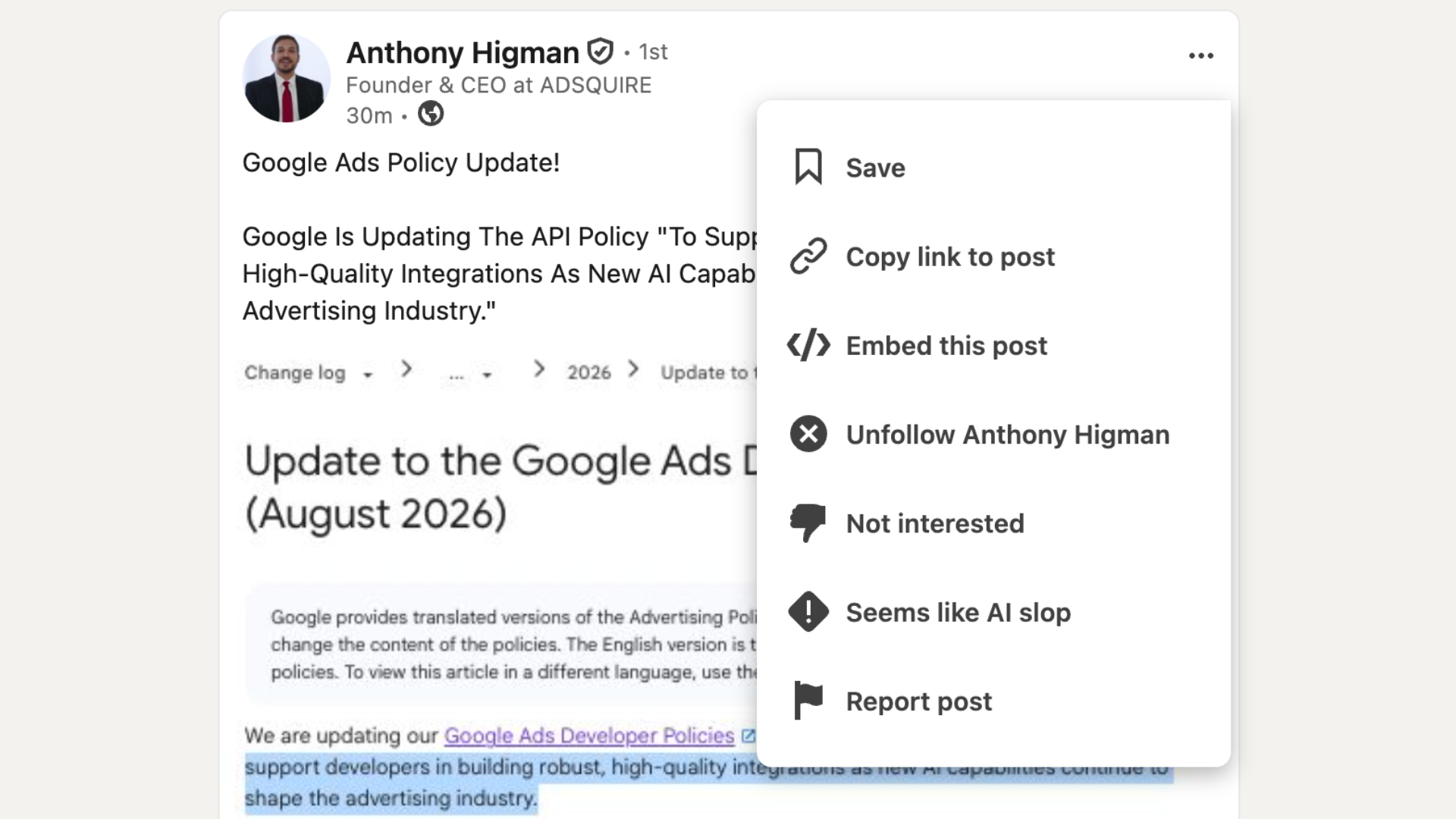
LinkedIn is testing a new way for users to flag low-quality content directly from their feed: a “Seems Like AI Slop” option.
The button gives users a way to report posts they believe are generic, low-effort, or overly reliant on artificial intelligence-generated content. Rather than simply hiding a post or unfollowing an account, LinkedIn is giving users a more direct way to signal that a piece of content doesn’t belong in their feed.
It’s a small feature, but it comes at a time when LinkedIn is dealing with a much bigger problem: the rise of AI-generated content across the platform.
What This Means for Marketers
AI has made it incredibly easy to produce LinkedIn content at scale. A single prompt can generate a polished-looking post in seconds, and that has led to an increasing amount of content that technically reads well but feels almost completely interchangeable.
You know the posts: generic business lessons, manufactured personal stories, vague leadership advice, and perfectly formatted paragraphs that say a lot without really saying anything.
The problem isn’t necessarily that AI was involved. AI can be a useful tool for brainstorming, editing, research, and content development. The problem is when the tool becomes the content strategy.
LinkedIn’s new feedback option suggests the platform is paying attention to that distinction. If enough users consistently signal that certain posts feel low-quality or artificially generated, that feedback can potentially help LinkedIn identify and deprioritize the type of content users don’t want to see.
For marketers, that’s another reason to focus on original perspectives, actual experiences, useful information, and a recognizable human voice rather than simply producing more content.
Our Take
We like seeing platforms try to re-prioritize real human content in the AI era.
The amount of AI-generated content on LinkedIn has exploded, and while there are plenty of legitimate uses for AI, the result can be a feed where everything starts to sound the same. More content doesn’t necessarily mean better content.
The “Seems Like AI Slop” button is obviously not going to solve that problem by itself. But giving users a way to identify content they consider generic or low-quality is a step in the right direction.
And ultimately, the best use of AI for marketers probably isn’t to eliminate the human element. It’s to make the human element easier to produce.
The marketers who continue to stand out will be the ones using AI to work faster while still bringing something AI can’t manufacture on its own: a real point of view, real experience, and something worth saying.
What ADSQUIRE Is Doing
At ADSQUIRE, we’re continuing to use AI as a tool—not a replacement for strategy or human judgment.
That means using it where it can make content development more efficient while keeping the actual ideas, perspective, and voice behind our content human.
Because in a feed increasingly filled with AI-generated content, sounding like an actual person is becoming a competitive advantage.
Conclusion
LinkedIn’s “Seems Like AI Slop” button is a small feature that reflects a much larger shift in social media.
AI is making content easier and cheaper to produce, but that also makes genuinely original content more valuable.
As platforms get better at identifying and responding to low-quality AI-generated content, marketers should be thinking less about how much content they can produce—and more about whether anyone actually wants to read it.