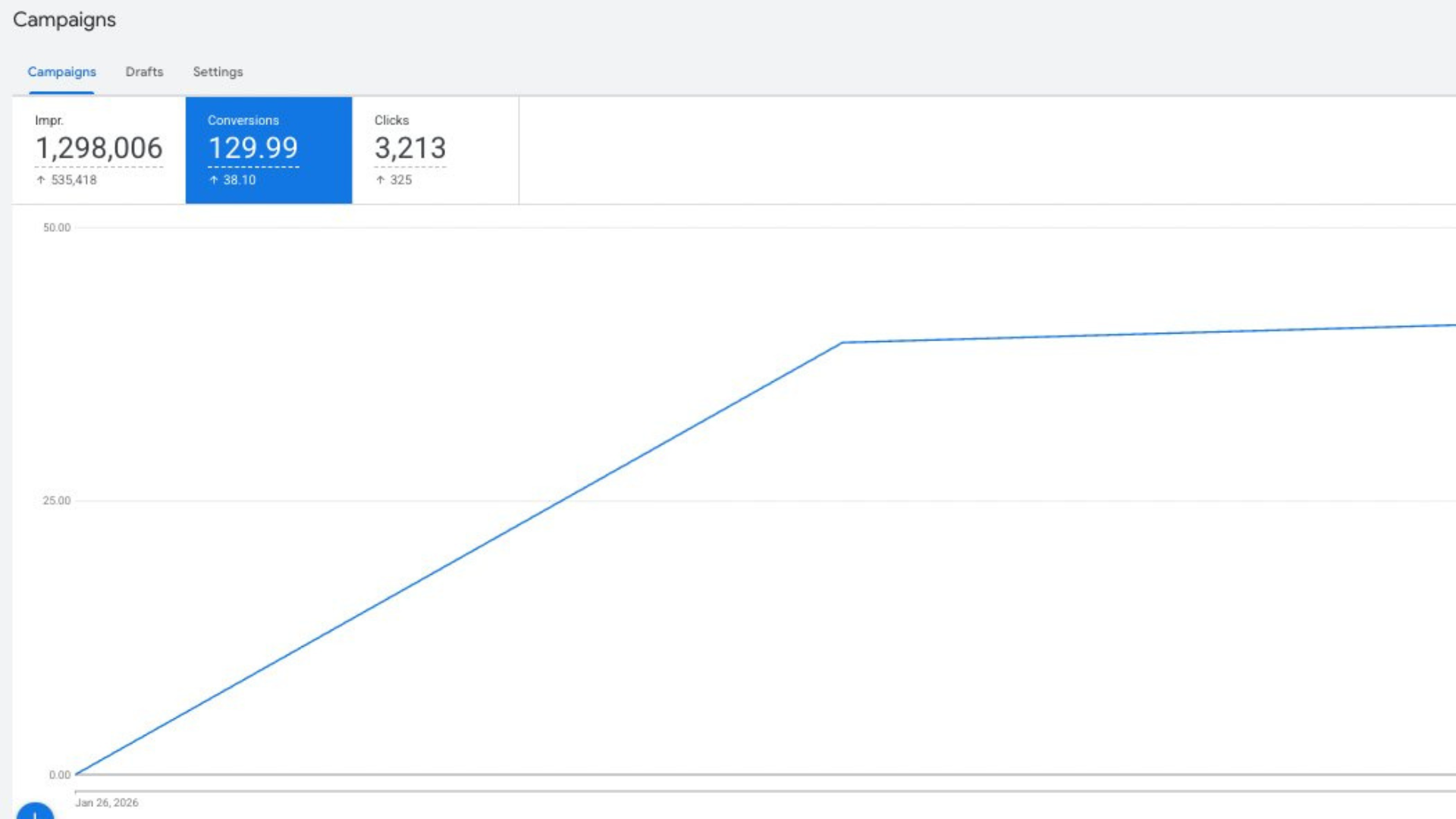
A small but noticeable change has been appearing across Google Ads accounts recently: the main performance graph is often showing only one metric — conversions — while cost metrics are removed from the default view.
At first glance, it looks like a simple UI tweak. But the pattern is appearing across multiple accounts and consistently defaults to conversion-only visualization, meaning advertisers have to manually re-add metrics like cost, cost-per-conversion, or spend to see the full financial picture.
Previously, the default view typically included a more balanced snapshot of performance — conversions alongside cost-related metrics. Now, advertisers are often greeted with a simplified graph focused solely on results, while the spending side of the equation sits hidden inside the metrics settings.
It’s a subtle shift, but it changes how performance is perceived at a glance.
What’s Changing
When logging into campaigns:
- The main graph frequently displays only conversions
- Cost and cost-related metrics are removed from the default visualization
- Advertisers must manually add spend metrics back into the view
- The default interface emphasizes outcomes without immediate cost context
For busy advertisers who rely on quick visual checks, that default framing can shape how performance is interpreted.
Why This Matters
Conversions alone never tell the full story in paid advertising.
Without cost context, a campaign might appear to be performing extremely well — even if the cost per conversion has quietly doubled. By requiring advertisers to dig into metrics to see spend data, the interface places less emphasis on the efficiency side of the equation.
For industries like legal, where clicks can cost $100+ and leads can run hundreds of dollars, visibility into cost performance is just as important as lead volume.
Our Take
This change feels less like a technical update and more like a presentation choice.
Google Ads is increasingly oriented around automation and AI-driven optimization, where the platform encourages advertisers to focus on conversion outcomes rather than granular cost control. Removing cost from the default view subtly reinforces that mindset.
But for high-cost industries like law firms, that approach can be risky. Performance isn’t defined by conversions alone — it’s defined by profitable conversions.
Any interface change that downplays spend metrics makes it even more important for advertisers to actively monitor efficiency.
What ADSQUIRE Is Doing
We’re making sure clients always see the full performance picture, not just the version the interface highlights.
Restoring Full Metric Visibility
- Reconfiguring account dashboards to display cost, CPA, and conversion metrics together
- Ensuring efficiency data is always visible at a glance
Monitoring Efficiency Trends
- Watching cost-per-lead and spend patterns closely
- Identifying when conversions increase but efficiency declines
Maintaining Strategic Oversight
- Evaluating campaigns based on true business outcomes, not just platform-reported success signals
- Ensuring optimization decisions prioritize lead quality and cost efficiency
Bottom Line
The Google Ads interface continues to evolve — and sometimes those changes subtly shape how advertisers interpret performance.
When conversion metrics are front and center while cost data is hidden by default, it becomes easier to celebrate results without fully evaluating the price paid to achieve them.
For law firms operating in high-CPC markets, keeping both sides of the equation visible — results and efficiency — remains essential. At ADSQUIRE, we make sure campaign performance is always measured by what actually matters: profitable growth, not just platform-reported wins.