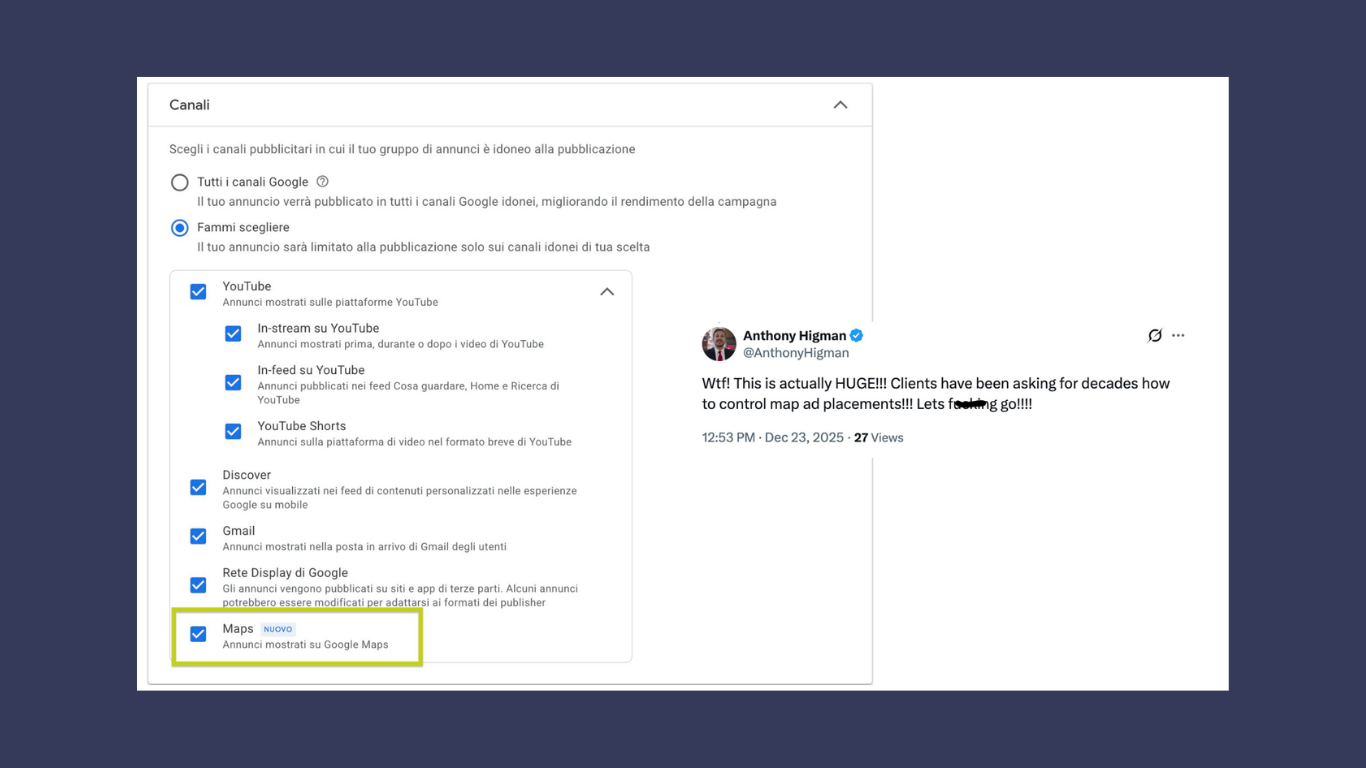
Google Ads is quietly rolling out a new channel control for Demand Gen campaigns: Google Maps. Some advertisers are now seeing the ability to specifically target Maps as a placement, allowing Demand Gen ads to surface directly within the Maps experience.
While still rolling out and not universally available, this update signals an important shift—especially for lawyers who have long asked for more control and visibility within Google Maps beyond traditional PPC Ads, LSA, and organic Google Business Profile results.
What’s New
Demand Gen campaigns can now include Google Maps as a targetable channel, alongside existing placements like YouTube, Discover, and Gmail.
Unlike standard search ads, this format blends discovery-style creative with location-driven intent, sitting somewhere between awareness and high-intent local engagement.
Importantly, this Maps channel-level control is the most direct step Google has taken towards giving advertisers the ability to solely target Maps placements.
Our Take
This is a meaningful update for lawyers.
Lawyers have long asked for a Maps-specific advertising option beyond organic GBP results. This update appears to be rolling out soon and could fulfill this exact need, although we are not sure exactly what it will look like yet. Maps is inherently high-intent: users are local, time-sensitive, and often deciding between immediate options.
Maps is a uniquely high-intent environment:
- Users are already location-aware
- They’re often searching with urgency
- Proximity and trust matter more than brand polish
For practice areas like personal injury, criminal defense, and DUI—where “near me” behavior is critical—Maps placements could help capture attention earlier in the decision process, before a user commits to calling or messaging a competitor.
That said, this won’t behave like LSAs or traditional search. Demand Gen is still a creative-first, audience-driven format, meaning performance will depend heavily on ad assets, messaging, and targeting strategies.
We also expect Google to continue testing and refining how Demand Gen ads appear in Maps, especially as AI-driven placements and local discovery continue to converge.
What ADSQUIRE Is Doing
We’re prepping to test this new channel control across Demand Gen campaigns for law firms once the update rolls out.
Our approach will include:
- Testing Maps-only, Maps-heavy, and mixed channel Demand Gen campaigns
- Comparing performance against Discover, YouTube, and Gmail placements
- Evaluating how Maps placements influence downstream actions like searches, calls, and GBP engagement
- Adjusting creative formats and CTAs to better match the Maps user mindset
We will also be closely watching how this interacts with LSAs and organic GBP visibility, ensuring campaigns complement—not cannibalize—each other.
As with any new Google rollout, we’re treating this as a testing phase, not a guaranteed win. Early data will determine where Maps placements make sense and where they don’t.
The Bottom Line
Google adding Maps as a Demand Gen channel is a notable step toward more flexible, location-aware advertising—something lawyers have been asking for for a long time.
While it’s not a true Maps-only targeting solution yet, it opens new opportunities to reach potential clients in high-intent local moments. Firms that test early, use the right formats, and understand how Maps fits into the broader funnel will be best positioned as this placement evolves.
As Google continues blending discovery, AI, and local intent, Maps is becoming less of a destination—and more of an advertising surface.